Foreign Institutional Exodus and Geopolitical Shock Trigger Sharp Correction in Indian Equities
- admin
- April 24, 2026
- Uncategorized
- 0 Comments
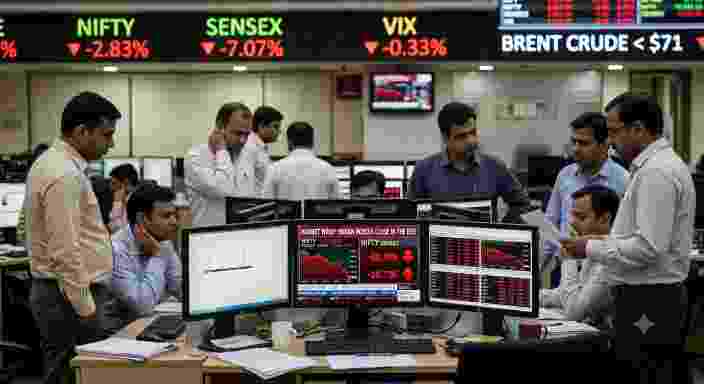
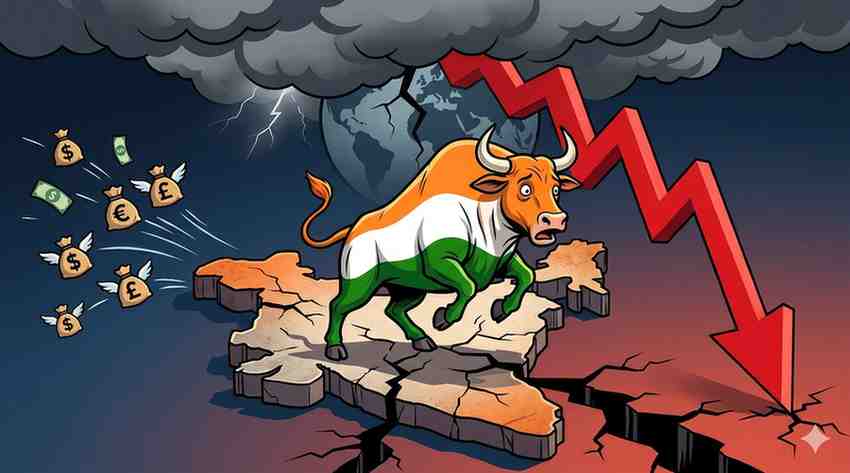
Indian benchmark indices Sensex and Nifty suffered a steep single-session decline driven by sustained foreign institutional investor (FII) outflows and escalating tensions in the Middle East. The dual shock has revived concerns about India’s vulnerability to global risk-off episodes despite strong domestic fundamentals.
New Delhi, April 2025 — The Bombay Stock Exchange’s Sensex and the National Stock Exchange’s Nifty 50 registered their sharpest intraday fall in several months as foreign portfolio investors accelerated their selling amid renewed geopolitical uncertainty in West Asia and a stronger dollar environment that has made emerging market assets less attractive to global capital allocators.
What Is Driving This Sell-Off?
Foreign institutional investors have withdrawn substantial capital from Indian equities over the past several trading sessions, reflecting a broader rotation away from emerging markets. The Middle East crisis has amplified risk aversion globally, pushing crude oil prices higher and raising concerns about imported inflation for energy-dependent economies like India. The US Federal Reserve’s persistent hawkish stance has strengthened the dollar index, further pressuring rupee-denominated assets. Indian markets, which had outperformed most Asian peers in the preceding quarter, became a natural target for profit-booking by foreign funds.
What Does This Mean for India?
The correction exposes the structural reliance of Indian equity markets on foreign portfolio flows, which account for roughly 18-20 percent of total market capitalisation in free-float terms. A sustained FII exodus could weaken the rupee, forcing the Reserve Bank of India to intervene in currency markets and potentially tighten domestic liquidity conditions. Higher crude prices threaten to widen the current account deficit and complicate the government’s fiscal arithmetic, particularly on fuel subsidy management. Domestic institutional investors and retail participants have provided some counterbalance, but their capacity to absorb prolonged foreign selling remains limited.
How Does This Compare Globally?
Indian indices have historically demonstrated relative resilience during global risk-off episodes compared to peers like Indonesia, South Korea, and Taiwan. The last comparable FII-driven correction occurred during the COVID-19 market crash of March 2020, when foreign investors pulled out over ₹60,000 crore in a single month. Current outflows, while significant, remain below those peak levels, suggesting this is a tactical rebalancing rather than a structural exit. Asian markets broadly declined in tandem, with MSCI Emerging Markets index falling over 2 percent in the same session.
- FII net selling has exceeded ₹15,000 crore over the past five trading sessions
- Brent crude prices surged past $90 per barrel on Middle East supply disruption fears
- The rupee weakened to near 84.50 against the US dollar, approaching its record low
- India VIX, the volatility gauge, spiked over 18 percent, signalling heightened uncertainty
- Domestic institutional investors recorded net purchases of approximately ₹8,000 crore in the same period
What Should Investors Watch?
Market participants should monitor crude oil price trajectories closely, as sustained levels above $95 per barrel would materially impact India’s macroeconomic stability. The RBI’s response through forex intervention or liquidity management tools will signal the central bank’s tolerance for currency depreciation. Quarterly earnings releases from IT and banking majors in the coming weeks will determine whether domestic fundamentals can offset global headwinds. Any de-escalation in Middle East tensions would likely trigger a swift recovery given India’s strong underlying growth narrative.
Analyst’s View
The current correction represents a liquidity-driven adjustment rather than a fundamental reassessment of India’s growth prospects. India’s macroeconomic buffers—including $620 billion in forex reserves and a resilient services export sector—provide meaningful insulation against external shocks. Markets may remain volatile in the near term as geopolitical risks persist, but the structural case for Indian equities remains intact for medium-term allocators. Investors should treat this dislocation as an opportunity for selective accumulation in quality large-caps rather than a signal for broad-based exits.