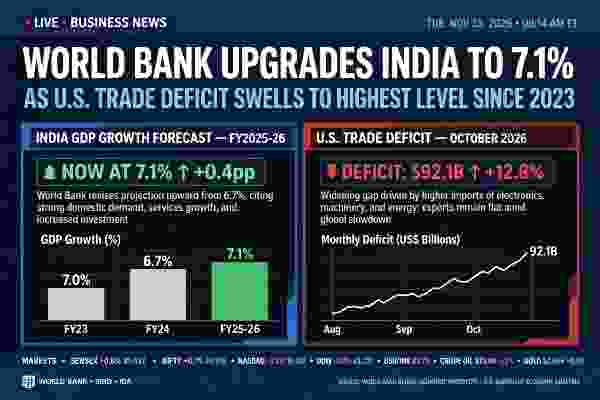
World Bank Upgrades India to 7.1% as U.S. Trade Deficit Swells
- Editor
- November 25, 2026
- Uncategorized
- 0 Comments
New Delhi, October 2026 — Two contrasting economic signals are defining the global outlook this month: India is powering ahead with a fresh vote of confidence from the World Bank, while the United States is grappling with a rapidly widening trade gap driven by its artificial intelligence buildout.
A Fresh Vote of Confidence for India
The World Bank has upgraded India’s FY27 GDP growth projection by 50 basis points, lifting it from 6.6% to 7.1%. The upward revision underscores India’s macroeconomic resilience at a time when much of the global economy faces uneven momentum.
Three core engines are doing the heavy lifting:
- Domestic Demand: Steady household consumption and services activity continue to anchor the economy.
- Strong Investment: Ongoing capital spending across physical and digital infrastructure is sustaining industrial momentum.
- Resilient Exports: Outbound shipments have held firm despite shifting global trade currents.
With India leading the charge, South Asia is projected to expand by 6.9% in 2026—retaining its spot as the world’s fastest-growing emerging-market region.
Near-Term Risks on the Radar
Even with the headline upgrade, economists are keeping a close eye on two familiar pressure points. Uneven monsoon rainfall poses a risk to agricultural output and rural demand, while elevated global energy prices could push up import bills and complicate inflation management.
America’s $105.6 Billion AI Import Bill
Halfway across the world, the United States is telling a very different trade story. The U.S. trade deficit swelled to $105.6 billion in August, jumping sharply from $92.8 billion in July.
The gap widened because imports outpaced exports by a wide margin. Total U.S. imports climbed 4.3%—with goods imports rising 5.3%—while exports edged up by just 1.4%. The primary culprit is Silicon Valley’s infrastructure race: American tech giants are importing massive volumes of semiconductors and specialized hardware to build out AI data centers.
Who Is Winning the Supply-Chain Shift?
The August trade numbers highlight a clear reality in global manufacturing. As American companies race to source AI hardware and industrial goods, the biggest beneficiaries are the export hubs feeding the U.S. market.
Mexico, Vietnam, and Taiwan captured the lion’s share of that trade-driven growth—accounting for the largest U.S. bilateral deficits in August at $27.7 billion, $24 billion, and $18.3 billion, respectively.
Two Economies, One Global Reality
Together, the numbers paint a sharp picture of today’s global economy. While America’s tech-fueled spending spree is pulling in record imports from global manufacturing hubs, India is proving that a strong domestic engine can keep growth accelerating even in a turbulent world.
For a deeper breakdown of the factors behind the upward revision, you can watch this DD India report on the World Bank’s 7.1% India growth forecast, which examines how domestic demand, exports, and industrial momentum drove the upgrade.