THE RUMOR MILL & THE BRICS SUMMIT: HOW A VIRAL HOAX FOOLED THE INTERNET
- Editor
- September 18, 2026
- Uncategorized
- 0 Comments
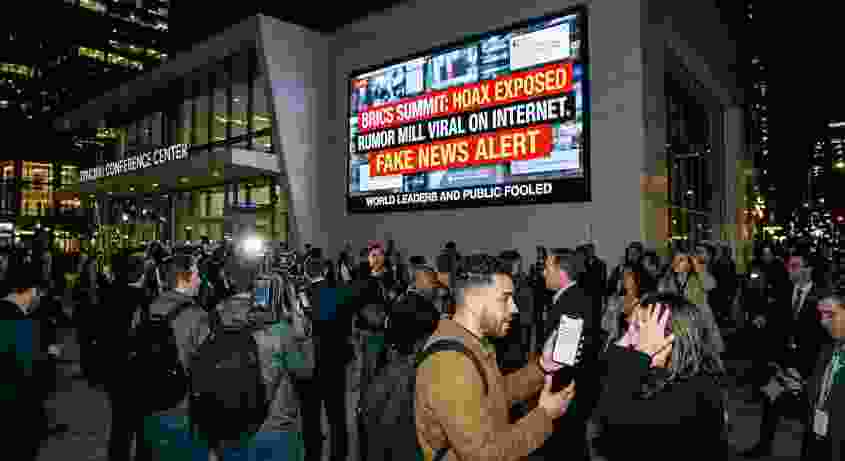
NEW DELHI — In an era where misinformation spreads faster than official reports, a single viral post can ignite international panic within hours. Recently, the internet was flooded with unverified claims asserting that multiple world leaders had fallen seriously ill following a high-profile BRICS summit hosted in India.
What began as a vague online post quickly morphed into a sensationalized international narrative—most notably claiming that Chinese President Xi Jinping had suffered a stroke, required emergency medical attention, and was airlifted to a Beijing hospital.
However, an in-depth investigation reveals a completely different reality: the entire story was a carefully constructed web of falsehoods, orchestrated by online prediction markets and political activists rather than mainstream journalists.
Selling a Narrative as “Reportedly True”
The sensational claims did not originate from reputable global news organizations like the BBC, CNN, or Reuters. Instead, the rumors traced back to two distinct sources: a US-based political activist and a decentralized online prediction market platform.
The rumor gained momentum through strategic, manipulative framing. Platforms posted vague statements claiming that “multiple” world leaders had fallen ill. Analysts note the use of words like “reportedly” and “multiple.” While the word “reportedly” acts as an intellectual shield for the publisher to evade accountability, the term “multiple” subtly shifts the narrative from an isolated health occurrence to a sinister pattern, forcing the public to question India’s safety and diplomatic hospitality.
Concurrently, detailed social media posts emerged from overseas political commentators, complete with hyper-specific medical terminology, helicopter call signs, and hospital room numbers. Experts warn that audiences frequently mistake high levels of detail for verifiable proof, assuming that fabricators would not invent complex data. In reality, adding specific numbers to a falsehood is effortless, whereas producing medical records, official statements, or photographic evidence remains difficult.
Separating Fact from Fiction
Official diplomatic records confirm that President Xi Jinping attended all scheduled engagements during the summit, held bilateral meetings, and departed smoothly for Beijing. While South African President Cyril Ramaphosa did experience a brief health setback—advising rest under medical supervision—his office never linked his condition to the summit or India. At 73 years of age, rigorous international travel can easily take a physical toll, entirely independent of diplomatic host nations.
Experts emphasize that the information vacuums created by secretive state apparatuses often invite speculation. Because heavily centralized governments rarely disclose routine health information transparently, digital opportunists readily fill the void with fictional drama. Furthermore, the financial incentives tied to modern prediction markets—where millions of dollars are wagered on political outcomes—have transformed online rumors into tradable commodities, driving the spread of sensational fabrications for financial gain.
The Dangers of Digital Amplification
Media analysts point out that digital populations in regions with heavy social media engagement frequently act as powerful amplifiers for unverified claims. When an exciting rumor matches a pre-existing bias or geo-political narrative, users rapidly share it without checking primary sources, inadvertently becoming part of a misinformation machine.
Ultimately, the BRICS summit proceeded smoothly, culminating in a comprehensive declaration and peaceful departures. The true crisis did not happen within diplomatic conference rooms, but inside digital networks where unverified rumors outpaced reality.
Bottom Line
The era of viral political rumors is rarely about authentic reporting—it is about exploiting psychological biases and financial markets while quietly draining public trust. With proper digital literacy and fact-checking, the masks come off: those who fabricated the panic rarely had evidence, and those who believed it fell victim to a carefully engineered illusion.