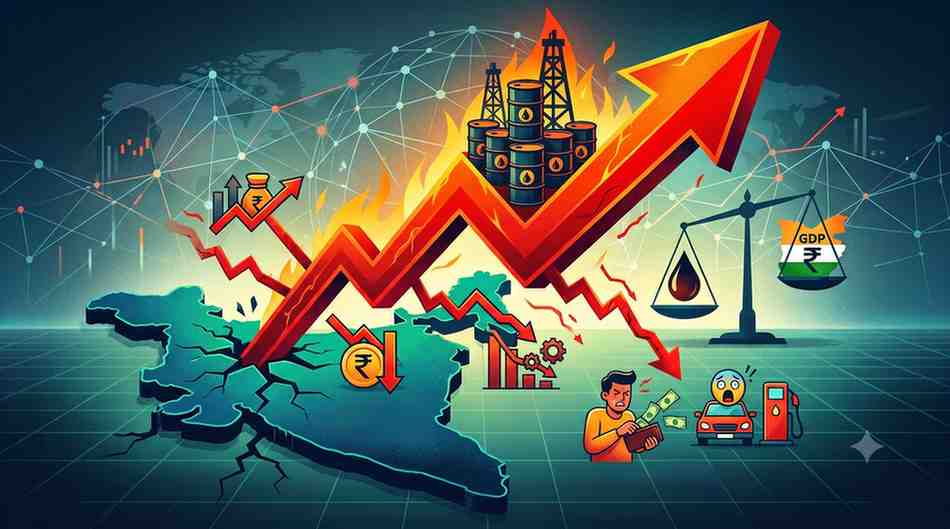
Surging Oil Prices: Implications for India’s Economic Landscape
The spike in oil prices to $105 per barrel poses significant challenges for India’s economic trajectory, potentially slowing growth and exerting pressure on the rupee. Policymakers and investors must navigate the implications of these higher energy costs on inflation and fiscal stability.
New Delhi, August 2026 — Oil prices have surged to $105 per barrel, a level not seen since mid-2014, raising alarm bells for the Indian economy, which is heavily reliant on crude imports. This price increase could inflate the current account deficit, thereby weakening the rupee and complicating the Reserve Bank of India’s (RBI) monetary policy decisions.
What Is Driving This?
Oil prices have been influenced by a convergence of geopolitical tensions, particularly in the Middle East, and supply chain disruptions exacerbated by the recent global economic recovery. OPEC’s production decisions, particularly any cuts to output, have also played a critical role in driving prices higher. The resurgence of demand as countries emerge from pandemic-related restrictions has further intensified this pressure.
What Does This Mean for India?
The implications for India are multifaceted. Higher oil prices may lead to increased inflation, as diesel and petrol prices impact transportation and logistics costs, which in turn affect consumer goods. Additionally, the rising oil import bill could widen the current account deficit, thereby putting downward pressure on the rupee, which has already been volatile against the dollar. Policymakers may have to balance growth and inflation, potentially leading to tighter monetary policy.
How Does This Compare Globally?
Globally, oil prices at $105 per barrel are not uniformly damaging, as some economies, particularly oil-exporting nations, stand to benefit significantly. However, emerging markets like India, which are net importers, face a stark contrast with their developed counterparts, who might absorb these shocks more easily. The divergence in economic health and resilience could lead to recalibrations in global trade dynamics and investment flows.
What Should Investors Watch?
- Monitor the RBI’s response to inflationary pressures and potential changes in interest rates.
- Keep an eye on the current account deficit metrics, which could inform currency stability.
- Assess sector-specific impacts, particularly on energy-intensive industries such as transportation and manufacturing.
- Evaluate geopolitical developments that could further influence oil supply and prices.
Analyst’s View
Analysts suggest that while the immediate impact of rising oil prices will be felt across multiple sectors, the long-term effects will depend on India’s ability to adapt through energy diversification and fiscal prudence. Investors should brace for volatility in the rupee and consider reallocating portfolios to hedge against inflationary risks. Policymakers must prioritize energy security measures to mitigate future shocks.