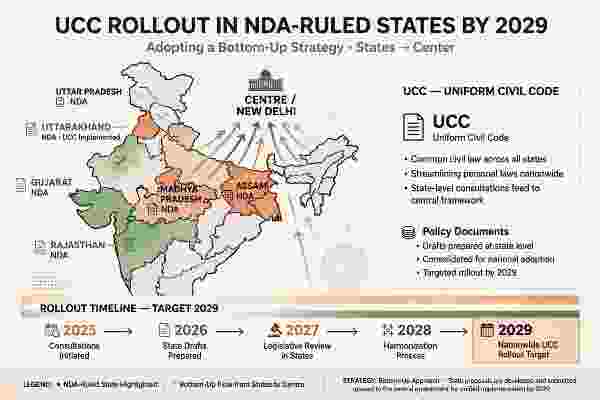
Amit Shah Sets 2029 Target for UCC Rollout in NDA-Ruled States, Adopting a “Bottom-Up” Strategy
- Editor
- September 16, 2026
- Uncategorized
- 0 Comments
New Delhi, September 2026 — Union Home Minister Amit Shah’s declaration to implement the Uniform Civil Code (UCC) across 21 NDA-ruled states before 2029 marks a fundamental shift in the government’s ideological playbook.
What supporters see as a historic stride toward gender justice, critics view as a politically calculated move that risks alienating minorities and tribal communities ahead of the next general elections.
The “Bottom-Up” Masterplan
For decades, the UCC was envisioned as a sweeping parliamentary act that would unify India’s personal laws overnight. In reality, the government’s new strategy is decentralized: bypassing a central mandate to use states as legislative laboratories.
By leveraging the Concurrent List of the Constitution—which allows state legislatures to draft their own laws on marriage, divorce, and succession—the BJP is rolling out the UCC piecemeal. This “bottom-up” approach aims to avoid massive nationwide protests by testing the waters locally and managing political risks state by state.
The Uttarakhand Blueprint
Uttarakhand has already become the pioneer, enforcing its version of the UCC in early 2025. While similar laws in Gujarat, Assam, and Madhya Pradesh await enforcement, the Uttarakhand model offers a clear glimpse into the future.
The law standardizes inheritance and divorce while strictly banning practices like polygamy. But it also introduced clauses that have sparked fierce national debate.
State Surveillance or Legal Protection?
The most contentious mandate in Uttarakhand’s UCC is the compulsory registration of live-in relationships.
The government argues this is necessary to protect vulnerable partners from exploitation and to legitimize children born out of wedlock. But behind the scenes, legal experts and civil rights advocates see a different reality:
State authorities are actively intruding into private relationships. By forcing consenting adults to register their living arrangements, critics argue the law blurs the line between legal protection and moral policing, effectively turning a private choice into a state-monitored affair.
A Fractured Consensus
Implementing a single code in a spectacularly diverse country is proving harder than anticipated. In the Northeast and central India, tribal communities fiercely protect their distinct, centuries-old customary family laws.
This has created a massive political tightrope. It isn’t just the traditional opposition resisting the move. Crucial NDA allies—including the TDP in Andhra Pradesh, JD(U) in Bihar, and LJP—have raised red flags, questioning the rapid push in regions with significant minority and tribal populations.
Equality or Majoritarianism?
The BJP insists the UCC is strictly about equality. The core argument: personal laws should not discriminate based on religion, and a uniform code guarantees gender justice across Hindu, Muslim, Christian, and Parsi communities alike.
Critics, however, warn that this imposed “uniformity” strips minorities of their personal autonomy and attempts to overwrite complex local traditions with a single majoritarian brush without adequate consultation.
Bottom Line
The push for a Uniform Civil Code by 2029 is no longer a distant theoretical debate—it is actively unfolding state by state. By taking the state legislative route, the government has found a clever workaround to national gridlock. However, it sets the stage for a complex legal patchwork where your personal liberties and family laws may soon depend entirely on which side of a state border you live on.