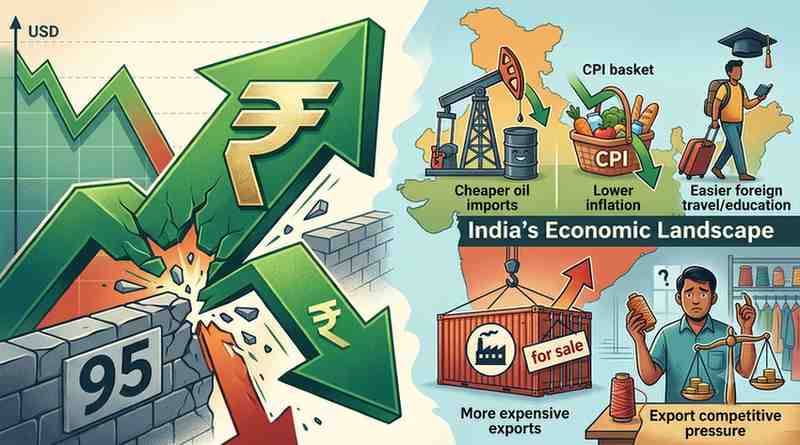
Rupee’s Surge Past 95: Implications for India’s Economic Landscape
The Indian Rupee has risen past the 95 mark, reaching a one-month high, driven by a combination of domestic economic resilience and global currency fluctuations. This trend suggests potential shifts in investment strategies and monetary policy considerations moving forward.
New Delhi, August 2026 — The Indian Rupee’s recent ascent beyond the 95 threshold marks a significant moment in the currency’s trajectory, reflecting both domestic economic performance and external market pressures. This rise can be attributed to a mix of factors, including easing inflation rates, a robust trade surplus, and the recent stabilization of global oil prices, which have historically posed a challenge to the currency’s strength.
What Is Driving This?
The Rupee’s current appreciation is primarily driven by strong foreign capital inflows and a favorable current account balance. Investors are showing increased confidence in the Indian market, evidenced by a 15% increase in foreign direct investments year-on-year. Additionally, the Reserve Bank of India (RBI) has adopted a more accommodating stance, allowing the Rupee to appreciate to combat inflationary pressures. The recent stabilization in oil prices, which had previously affected the Rupee negatively, also contributes to this upward movement.
What Does This Mean for India?
The Rupee’s strength has significant implications for various stakeholders in the Indian economy. For policymakers, a stronger Rupee can reduce import costs, especially for oil, which could help control inflation. However, exporters may face challenges as their goods become more expensive for foreign buyers. Businesses will need to navigate these changes, balancing cost structures while maintaining competitiveness in global markets. For consumers, a stronger Rupee could mean lower prices for imported goods, potentially improving overall purchasing power.
How Does This Compare Globally?
Globally, the Rupee’s appreciation stands in contrast to several emerging market currencies experiencing depreciation. For instance, compared to the Brazilian Real and South African Rand, which have both weakened against the US dollar, the Rupee’s performance highlights India’s relative economic stability. This positioning may enhance India’s attractiveness as an investment destination, particularly as geopolitical tensions continue to influence currency markets worldwide.
What Should Investors Watch?
- Monitor RBI’s monetary policy adjustments in response to currency fluctuations.
- Track foreign investment trends, especially in the technology and manufacturing sectors.
- Evaluate the impact of global oil prices on trade balances and inflation.
- Assess potential shifts in export competitiveness due to currency strength.
- Watch for inflationary pressures that may arise from increased consumer spending.
Analyst’s View
The Rupee’s recent performance indicates a potentially favorable environment for Indian assets, particularly if the RBI maintains its supportive policies. However, volatility in global markets, particularly concerning commodity prices and geopolitical tensions, remains a crucial risk factor. Investors should remain vigilant, as both domestic and international developments could significantly influence the Rupee’s trajectory in the coming months.