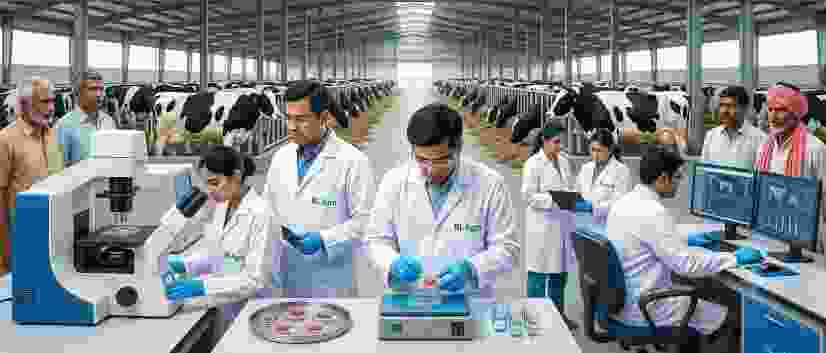
THE GREAT CATTLE REBOOT: BL Agro Pours ₹1,500 Crore into Advanced Genetics to Supercharge India’s Dairy Economy
- Editor
- September 19, 2026
- Uncategorized
- 0 Comments
New Delhi, September 2026 — BL Agro has launched a massive ₹1,500-crore offensive into the heart of India’s agricultural backbone, aiming to rewrite the future of the nation’s dairy industry.
What company backers hail as a revolutionary technological leap to fix India’s low milk productivity, critics and animal welfare advocates argue is a high-stakes biological gamble that brings complex ethical and physiological questions to the dinner table.
Fixing India’s Productivity Paradox
For decades, India has proudly held its crown as the world’s largest producer of milk. Yet, behind the macro numbers lies a stark, quiet inefficiency: per-cattle milk yield in India trails far behind international standards.
While millions of rural households rely on cattle farming for survival, the average Indian cow or buffalo produces a fraction of the output seen in Western or Latin American dairy powerhouses. Through its biotech subsidiary, Leads Genetics, BL Agro is deploying a ₹1,500-crore war chest to bridge this gap [1.1.39]. The target is staggering: setting up advanced IVF-ET (In Vitro Embryo Transfer) laboratories and genomics hubs to manufacture 15,000 elite embryos a month by the end of 2027.
Science in the Shed: The Push for Genetically Modified Dairy
The roadmap relies heavily on cutting-edge reproductive science rather than traditional breeding. By utilizing high-yield genetic strains, the company aims to engineer cattle that can exponentially multiply milk output.
In a sector historically slow to modernize, this push introduces intensive biological intervention. Proponents argue that upgrading cattle genetics is the only logical way to secure food security and boost farmers’ incomes. However, it also pulls back the curtain on modern dairy farming methods—where maintaining high yields has long involved rigorous hormonal cycles and intense physiological manipulation.
The Hidden Cost of the Glass of Milk
For years, the commercial dairy machine has relied on keeping cows in constant reproductive cycles, often driven by growth hormones and artificial stimuli to maximize output. Critics have long pointed out that these intense production demands take a heavy toll on the health of the animals, raising questions about long-term sustainability and animal welfare.
On the other hand, defenders of agricultural biotechnology point out a pragmatic reality: much of the modern food supply is already genetically modified or technologically optimized. What sounds alarming on paper is often standard practice in global agriculture. If gene-edited cattle can deliver cleaner, higher yields with lesser environmental strain per liter of milk, supporters argue it could reshape the economics of rural India [1.1.33].
A Multibillion-Dollar Bet on Biological Engineering
The sheer scale of the investment signals a structural shift. Agribusiness is no longer just about land, fodder, and manual labor; it is transitioning into a high-tech bioscience battleground.
Whether BL Agro’s massive embryo pipeline will successfully revolutionize local dairy sheds without triggering ecological or ethical pushback remains to be seen. But one thing is certain: the traditional image of the Indian dairy farmer is undergoing a high-tech overhaul.
Bottom Line
The ₹1,500-crore plunge into cattle genetics is not just about producing more milk—it is an aggressive bid to drag India’s ancient dairy economy into the age of molecular biology. As the labs ramp up production toward 2027, the real test will not just be how many liters a cow can yield, but whether consumers and farmers are ready to accept a heavily engineered future for their daily glass of milk.