Perception Over Capability: The EU’s Indo-Pacific Challenge Unveiled
- admin
- August 6, 2026
- Uncategorized
- 0 Comments
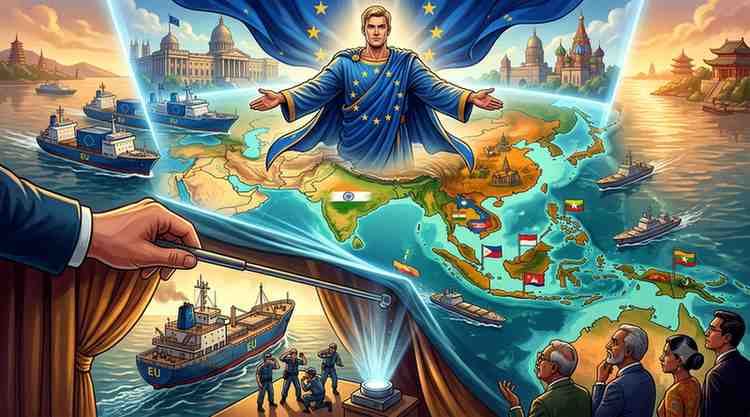
The European Union’s challenge in the Indo-Pacific region arises primarily from its perceived lack of strategic relevance rather than from any deficiencies in capability. This perception hampers the EU’s ability to assert its influence amidst rising geopolitical tensions.
New Delhi, August 2026 — The European Union (EU) has recently been criticized for its approach to the Indo-Pacific, with analysts suggesting that the core issue lies not in its military or economic capabilities but rather in how these capabilities are perceived by regional stakeholders. As China expands its influence and the United States recalibrates its foreign policy, the EU’s perceived hesitance diminishes its role as a key player in this strategically vital area.
What Is Driving This?
The EU’s approach to the Indo-Pacific has often been viewed as reactive rather than proactive. Policymakers in Brussels have articulated a vision of a rules-based global order, yet this vision fails to resonate strongly with Asian nations that seek concrete actions. The EU’s commitment to regional partnerships has been overshadowed by its internal challenges, including differing member state priorities and a lack of unified strategic vision. Moreover, the growing assertiveness of China complicates the EU’s ability to project power effectively.
What Does This Mean for India?
India stands at a crossroads in its relations with the EU and the broader Indo-Pacific. As a key player in regional stability, India’s interests align with those of the EU, particularly regarding maritime security and trade. However, India’s perception of the EU’s commitment to the region is critical in determining future collaborations. If the EU can enhance its strategic visibility and reliability, it may bolster India’s confidence in forming deeper ties, particularly in counterbalancing China’s influence.
How Does This Compare Globally?
Globally, the EU’s situation contrasts sharply with that of the United States, which has consistently reinforced its presence in the Indo-Pacific through military alliances and economic partnerships. The U.S. Indo-Pacific strategy, characterized by the Quad and AUKUS partnerships, sets a high bar for the EU to match. Nations like Japan and Australia have also taken more assertive stances in the region, further highlighting the EU’s passive image. This discrepancy emphasizes the urgency for the EU to redefine its role and enhance its perception among global powers.
What Should Investors Watch?
- Potential shifts in EU policy that may affect trade agreements in the Indo-Pacific.
- Increased defense spending by EU member states aimed at enhancing regional security.
- Developments in EU-India relations, especially in technology and infrastructure.
- Changes in the geopolitical landscape due to China’s actions in the South China Sea.
- Impact of EU’s perception on investment flows in the Indo-Pacific region.
Analyst’s View
The EU must urgently address its perception problem to solidify its standing in the Indo-Pacific. A strategic overhaul that emphasizes both military readiness and diplomatic engagement will be crucial. By strengthening partnerships and enhancing its visibility, the EU can position itself as a vital player in shaping the future of the Indo-Pacific, ultimately influencing global power dynamics.