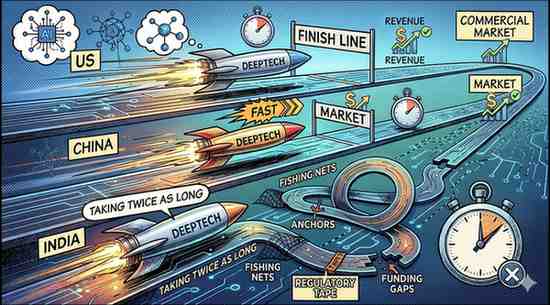
Why India’s Deeptech Startups Take Twice as Long to Commercialise Compared to US and China
- admin
- April 21, 2026
- Uncategorized
- 0 Comments
India’s deeptech ecosystem faces a critical bottleneck where laboratory innovations require 7-10 years to reach commercial markets, nearly double the timeline in competing economies like the United States and China. Structural reforms in intellectual property frameworks, public procurement policies, and academia-industry linkages are now being urged to compress this innovation cycle and unlock India’s scientific potential.
New Delhi, April 2025 — India produces the third-highest number of STEM graduates globally, yet converts a disproportionately small fraction of fundamental research into market-ready deeptech products. The persistent lag between laboratory breakthroughs and commercial deployment has emerged as a structural impediment to India’s ambitions in semiconductors, space technology, advanced materials, and biotechnology — sectors where global leadership increasingly determines economic competitiveness.
What Is Driving India’s Lab-to-Market Delay?
India’s deeptech commercialisation gap stems from fragmented institutional frameworks that separate research funding from market validation. Public research institutions operate under rigid mandates that discourage risk-taking and commercial partnerships. Technology transfer offices at premier institutions like the IITs remain understaffed and lack the legal expertise to negotiate complex licensing agreements. Private capital continues to favour consumer internet and fintech ventures with faster payback periods, leaving capital-intensive deeptech ventures chronically underfunded during the critical prototype-to-product phase.
How Does India Compare Globally?
China’s deeptech startups benefit from state-backed procurement guarantees that provide revenue visibility during early commercialisation stages. Israel’s innovation ecosystem leverages mandatory military technology transfers and dense academia-defence linkages. The United States deploys agencies like DARPA to bridge the “valley of death” between research grants and venture funding. India’s comparable mechanisms — including the Technology Development Board and various mission-mode programmes — remain siloed across ministries with limited coordination and inconsistent funding cycles.
What Reforms Are Being Proposed?
Industry bodies and policy advisors are advocating for a unified National Deeptech Mission with dedicated procurement commitments from government departments. Recommendations include amending the General Financial Rules to permit risk-tolerant purchasing of domestically developed technologies, even when cheaper imports exist. Intellectual property reforms focusing on faster patent examination — currently averaging 58 months in India versus 23 months in China — feature prominently in the proposed agenda.
- India’s average patent grant timeline stands at 58 months, compared to 23 months in China and 24 months in the United States
- Deeptech startups in India raised approximately $2.3 billion in 2024, representing just 8% of total startup funding
- Only 3-5% of patents filed by Indian public research institutions result in commercial licensing agreements
- China’s government procurement for indigenous technology exceeded $180 billion in 2024, dwarfing India’s equivalent allocations
- India’s R&D expenditure remains at 0.7% of GDP, against the global average of 1.8% and China’s 2.4%
What Does This Mean for Investors and Industry?
Venture capital firms focusing on deeptech must factor extended holding periods and higher capital requirements into their fund structures. Corporate India faces strategic choices between acquiring foreign technology licenses and investing in domestic R&D ecosystems with uncertain timelines. Manufacturing initiatives like the Production-Linked Incentive schemes risk creating assembly operations without genuine technology depth if upstream innovation pipelines remain constrained.
Analyst’s View
India’s deeptech challenge is fundamentally a coordination failure rather than a talent deficit. The incoming fiscal year’s budget allocations to the Anusandhan National Research Foundation and semiconductor mission implementation will signal whether policymakers are prepared to accept higher short-term costs for long-term technological sovereignty. Watch for changes in public procurement rules favouring domestic deeptech — this single reform could compress commercialisation timelines more effectively than additional R&D funding alone. Without structural intervention, India risks remaining a consumer of frontier technologies rather than a producer, with lasting implications for its current account and strategic autonomy.