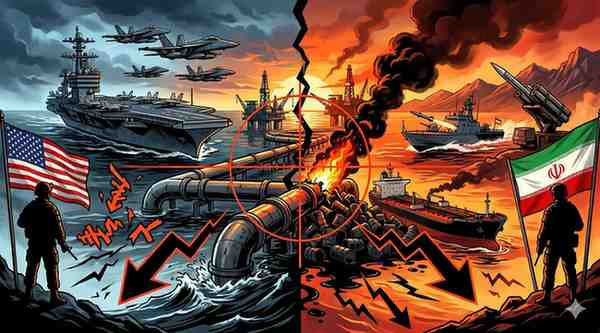
US-Iran Conflict Threatens 600 Million Barrel Supply Shock: What a 2026 Energy Crisis Means for Global Markets
- admin
- April 21, 2026
- Uncategorized
- 0 Comments
A potential US-Iran military confrontation could remove approximately 600 million barrels from global oil supply, triggering natural gas price surges of 47% and jet fuel increases exceeding 100%. This supply disruption would constitute the most severe energy shock since the 1973 Arab oil embargo, fundamentally reshaping inflation trajectories, central bank policies, and emerging market vulnerabilities worldwide.
New Delhi, April 2026 — Global energy markets are pricing in catastrophic disruption scenarios as US-Iran tensions escalate toward potential military conflict, with commodity analysts warning that a sustained closure of the Strait of Hormuz could eliminate roughly 20% of daily global oil transit within weeks. The 600 million barrel supply deficit projection assumes a three-to-six month disruption period, a timeline that would exhaust strategic petroleum reserves across most importing nations.
What Is Driving This Supply Crisis Scenario?
The Strait of Hormuz handles approximately 21 million barrels of oil daily, representing one-fifth of global petroleum consumption. Iran’s geographic position grants Tehran effective chokepoint control over energy exports from Saudi Arabia, Iraq, Kuwait, Qatar, and the UAE. Previous Hormuz disruption threats during the 2019 tanker attacks caused immediate 4% oil price spikes despite no actual supply interruption. Military analysts suggest that unlike limited skirmishes, a full-scale conflict would trigger Iranian mining operations, drone strikes on tanker traffic, and attacks on Gulf state loading terminals simultaneously.
What Does This Mean for India?
India’s economy faces disproportionate exposure given its 85% petroleum import dependence and limited strategic reserve capacity of approximately 40 days consumption. The Reserve Bank of India’s inflation targeting framework would face severe stress, as a 100% jet fuel price increase would cascade through transportation, logistics, and consumer goods sectors within 60-90 days. Indian refiners including Reliance Industries and Indian Oil Corporation have historically maintained diversified crude sourcing, but Hormuz closure would affect Iraqi and Saudi supplies that constitute over 40% of Indian imports. The current account deficit could widen beyond 4% of GDP under sustained $150-per-barrel crude scenarios.
How Does This Compare to Previous Energy Shocks?
The projected magnitude exceeds the 2022 Russia-Ukraine supply disruption, which removed approximately 3 million barrels daily from European markets. The 1990 Gulf War caused crude prices to double within three months but affected only Kuwaiti and Iraqi output. A Hormuz closure would simultaneously impact six major producing nations, creating supply concentration risk that strategic reserve releases cannot meaningfully offset.
- 600 million barrels: estimated cumulative supply deficit over disruption period
- 47% natural gas price increase: projected impact on LNG spot markets as Gulf exporters face shipping constraints
- 100% jet fuel surge: aviation sector faces acute margin compression and potential capacity reductions
- 21 million barrels daily: current Hormuz transit volume at risk
- 40 days: India’s current strategic petroleum reserve capacity versus 90+ days for IEA member nations
What Should Investors Watch?
Energy sector hedging activity has intensified across derivatives markets, with Brent crude options volatility reaching 18-month highs. Defence and aerospace equities in NATO-aligned markets show elevated buying pressure, while emerging market currencies with energy import dependence—including the Indian rupee, Turkish lira, and Thai baht—face sustained depreciation risk. Fixed income markets should anticipate hawkish central bank pivots as energy-driven inflation complicates monetary easing cycles globally.
Analyst’s View
The probability-weighted impact on Indian markets warrants immediate portfolio stress-testing against $140-160 crude scenarios. Policymakers should accelerate strategic reserve expansion and expedite alternative supply agreements with non-Hormuz producers including the United States, Brazil, and West African exporters. The coming 90 days will determine whether diplomatic de-escalation prevents the most severe energy supply crisis in half a century—or whether 2026 becomes a structural reset year for global energy security architecture.