Why Indian Markets Shed ₹12 Lakh Crore in a Single Session: Anatomy of the April Selloff
- admin
- April 15, 2026
- Uncategorized
- 0 Comments
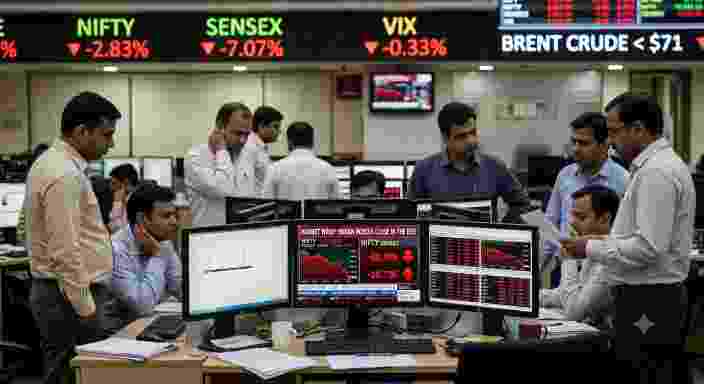
Indian equity markets witnessed their steepest single-day decline in 2025, with the Sensex plunging 1,352 points and the Nifty breaching the critical 24,050 support level amid a confluence of global and domestic pressures. The selloff, which erased approximately ₹12 lakh crore in investor wealth, reflects deepening concerns over global trade tensions, foreign capital flight, and weakening corporate earnings momentum.
New Delhi, April 2025 — The benchmark Sensex closed at its lowest level since November 2024, as panic selling gripped Dalal Street with all thirty index constituents ending in the red. Foreign institutional investors have now sold Indian equities for eighteen consecutive sessions, withdrawing over ₹45,000 crore in April alone — the longest selling streak since the 2008 financial crisis.
What Is Driving This Market Correction?
Six distinct factors have converged to trigger this sharp correction in Indian equities. Escalating global trade tensions, particularly renewed tariff threats between the United States and China, have rattled emerging market sentiment worldwide. Crude oil prices breaching $92 per barrel have rekindled inflation concerns for import-dependent India, threatening the Reserve Bank of India’s accommodative stance. Disappointing Q4 FY25 earnings from bellwether companies in banking and information technology have forced analysts to revise full-year estimates downward. The rupee’s slide past 86.5 against the dollar has amplified foreign portfolio outflows as currency hedging costs erode returns for overseas investors.
How Does This Compare to Previous Market Selloffs?
The current correction marks the Nifty’s sixth decline exceeding 5% in a calendar year since 2020. India’s market capitalisation-to-GDP ratio had climbed to 124% in January 2025, surpassing the previous peak of 103% witnessed before the 2008 crash — a valuation stretched by historical standards. The Nifty’s price-to-earnings multiple has compressed from 23.4x in December to 19.8x currently, approaching the five-year average of 19.2x. This repricing mirrors the correction seen in October 2023, though the pace of decline has been notably more severe.
What Does This Mean for Different Stakeholders?
Retail investors, who had accumulated record demat accounts exceeding 15 crore, now face margin calls and portfolio drawdowns averaging 18% from recent peaks. Mutual fund houses are experiencing their first net equity outflows since March 2020, disrupting the systematic investment plan flows that had provided market stability. Corporate India confronts a narrowing window for initial public offerings and qualified institutional placements, with several planned issuances now postponed indefinitely. The government’s disinvestment programme faces headwinds, potentially affecting fiscal deficit targets for FY26.
- Sensex decline of 1,352 points represents a 4.8% single-session fall, the worst since June 2024
- Foreign institutional investors have withdrawn ₹1.2 lakh crore from Indian equities since January 2025
- India VIX, the volatility index, spiked 32% to 19.4, signalling elevated near-term uncertainty
- Midcap and smallcap indices have corrected 22% and 28% respectively from their December 2024 highs
- Banking stocks contributed 480 points to the Sensex decline, with HDFC Bank and ICICI Bank leading losses
What Should Investors Watch Next?
Market participants should monitor three critical triggers in the coming fortnight. The RBI’s monetary policy committee meeting on April 28-30 will signal whether rate cuts remain on the table despite rupee weakness. Q4 earnings from Reliance Industries and TCS this week will establish the tone for broader market sentiment. Global cues from the US Federal Reserve’s May meeting and any de-escalation in trade tensions could provide relief rallies.
Analyst’s View
The current selloff represents a painful but arguably necessary valuation reset for Indian equities that had outpaced earnings growth for consecutive quarters. Long-term investors with 3-5 year horizons may find selective accumulation opportunities in quality financials and consumption names trading below historical averages. The structural India growth story remains intact, but near-term volatility will persist until foreign flows stabilise and global risk appetite recovers. Markets are unlikely to find a durable floor until the Nifty tests the 23,200-23,500 zone, which aligns with the 200-week moving average — a level last breached during the March 2023 banking turbulence.