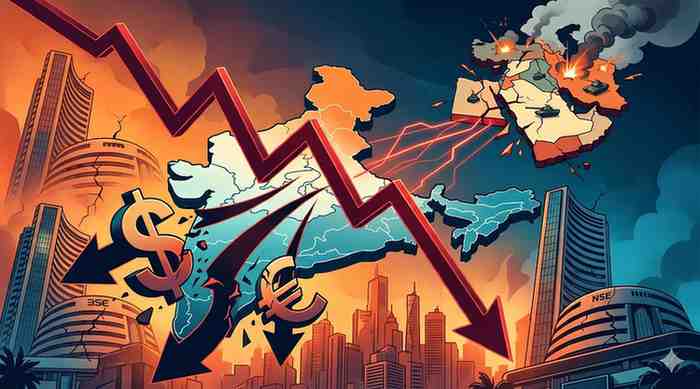
Why FII Exodus and Middle East Tensions Are Triggering India’s Sharpest Market Correction Since October 2023
- admin
- April 15, 2026
- Uncategorized
- 0 Comments
Indian benchmark indices Sensex and Nifty have experienced a sharp sell-off driven by sustained foreign institutional investor outflows compounded by escalating geopolitical tensions in the Middle East. The dual pressure of capital flight and crude oil supply risk has exposed vulnerabilities in India’s equity markets that had appeared resilient through early 2025.
New Delhi, April 2025 — The Bombay Stock Exchange’s Sensex plunged over 1,200 points in intraday trading while the NSE Nifty breached critical support levels, marking the steepest single-session decline since the Israel-Hamas conflict intensified in October 2023. Foreign institutional investors have now recorded net outflows exceeding ₹18,000 crore over the past eight trading sessions, reversing the tentative return of overseas capital witnessed in March.
What Is Driving This Market Correction?
Foreign institutional investors have accelerated their exit from Indian equities as risk-off sentiment grips emerging markets globally. The immediate catalyst stems from renewed military escalation in the Middle East, which has pushed Brent crude prices above $92 per barrel for the first time since late 2023. India’s import dependency for over 85 percent of its crude requirements means elevated oil prices directly compress corporate margins and widen the current account deficit. The rupee has simultaneously weakened past 84.5 against the dollar, creating a negative feedback loop that amplifies FII selling pressure.
What Does This Mean for India’s Economic Outlook?
The market correction arrives at a precarious moment for India’s growth trajectory. Reserve Bank of India Governor Shaktikanta Das had signalled cautious optimism about inflation moderating toward the 4 percent target by mid-2025, but sustained crude price spikes threaten to derail that projection. Every $10 per barrel increase in oil prices historically adds approximately 30-40 basis points to India’s headline inflation. The government’s fiscal calculations for FY26, which assumed crude at $80-82 per barrel, now face potential subsidy overruns that could pressure the 4.5 percent deficit target.
How Does This Compare to Previous Market Shocks?
The current sell-off echoes patterns observed during the 2022 Russia-Ukraine crisis and the 2018 oil shock triggered by Iran sanctions. In both instances, FII outflows persisted for 8-12 weeks before stabilising. Domestic institutional investors have partially offset the selling pressure this time, deploying over ₹12,000 crore through mutual fund purchases, demonstrating the structural maturity Indian markets have developed since 2020. Retail systematic investment plan flows remain robust at approximately ₹20,000 crore monthly, providing a floor that did not exist during earlier crises.
- Sensex declined over 1,200 points intraday; Nifty breached 22,000 support level
- FII net outflows exceeded ₹18,000 crore over eight consecutive sessions
- Brent crude surged past $92/barrel on Middle East supply disruption fears
- Indian rupee weakened beyond 84.5/USD, lowest since January 2025
- DII buying of ₹12,000 crore partially cushioned foreign selling pressure
What Should Investors Watch Next?
Market participants should monitor three key indicators over the coming fortnight. First, the trajectory of US Federal Reserve commentary on rate cuts will determine whether emerging market capital flows stabilise or deteriorate further. Second, any diplomatic resolution or escalation in the Middle East will directly impact crude price expectations and energy-sensitive sectors. Third, quarterly earnings releases from IT majors TCS and Infosys this week will test whether domestic fundamentals can provide a counter-narrative to macro headwinds.
Analyst’s View
The current correction represents a repricing of geopolitical risk rather than a fundamental deterioration in India’s growth story. Markets had priced in an optimistic scenario of steady disinflation, Federal Reserve easing, and stable oil through 2025—assumptions now under strain. The divergence between FII pessimism and DII resilience suggests domestic conviction in India’s structural narrative remains intact. However, if Brent sustains above $95 for more than four weeks, the RBI’s rate-cut calculus shifts materially, and the correction could deepen toward Nifty 21,200 levels. Investors should watch the April inflation print and RBI’s June policy stance as critical signposts for market direction.