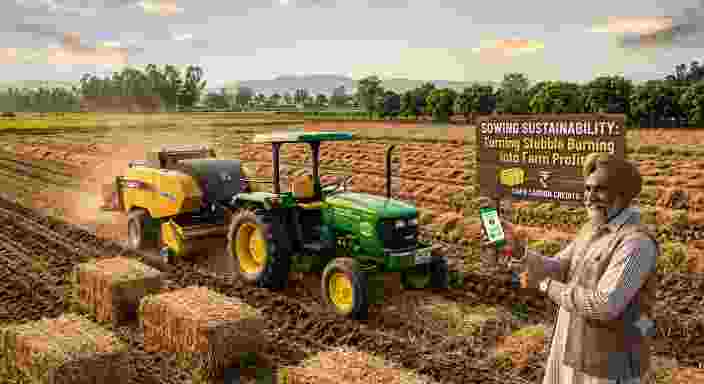
Sowing Sustainability: How Carbon Credits Are Turning Stubble Burning into Farm Profits
- Editor
- September 17, 2026
- Uncategorized
- 0 Comments
CHANDIGARH / NEW DELHI — In a major breakthrough for both agricultural economics and climate action, 2,550 farmers across the agrarian states of Punjab and Haryana have been financially rewarded for adopting sustainable farming practices.
Spearheaded by an ag-tech organization named Grow Indigo, the initiative has successfully paid these farmers between ₹3,000 and ₹15,000 for generating high-quality soil carbon credits.
This development presents a highly lucrative and scalable alternative to the deeply entrenched, environmentally disastrous practice of stubble (crop residue) burning, which chokes Northern India in toxic smog every winter.
Here is an in-depth breakdown of how this carbon-farming economy operates, its financial mechanism, and why it represents a paradigm shift for Indian agriculture.
Segment 1: The Stubble Burning Crisis and the Economic Bottleneck
To understand the significance of this carbon credit initiative, one must understand why farmers burn stubble in the first place. The crisis is rooted in the intensive dual-cropping system of rice and wheat.
- The Time Crunch: Farmers in Punjab and Haryana have an incredibly narrow window—often just two to three weeks in October and November—between harvesting their paddy (rice) crop and sowing the winter wheat crop.
- The Cost of Clearing: Clearing the leftover rice stalks (stubble) mechanically is expensive, time-consuming, and requires specialized machinery. Conversely, setting the field on fire is fast, clears pests, and costs almost nothing.
- The Fall Out: This practice contributes up to 35% of the severe air pollution that blankets Delhi and North India during the winter. Furthermore, the intense heat of the fires degrades the soil, destroying vital nutrients and organic matter, which ultimately forces farmers to spend more on chemical fertilizers.
For years, the government has tried to stop the burning through a mix of punitive fines and subsidies for heavy machinery, with limited success. The core issue remained unsolved: there was no direct, immediate financial incentive for a smallholder farmer to change their behavior.
Segment 2: Enter “Carbon Farming”
Organizations like Grow Indigo are fundamentally changing the economic equation by introducing “carbon farming.” This is a system of agricultural management where farmers are paid to implement practices that store carbon in the soil and reduce greenhouse gas emissions, rather than releasing them into the atmosphere.
- The Mechanism: Instead of burning the stubble, farmers are trained in regenerative practices. This includes utilizing early-maturing seed varieties (which give them more time to clear fields), incorporating the crop residue back into the earth, minimizing tillage, and optimizing fertilizer use.
- The Ecological Benefit: These practices rebuild healthy, living soil. The organic matter from the unburned stubble enriches the earth, improves water retention, and actively pulls carbon dioxide out of the atmosphere, storing it safely underground.
Segment 3: Monetizing the Earth — How the Credits Work
The environmental benefits are clear, but the financial engine driving this transition is the Voluntary Carbon Market (VCM).
- Measurement and Verification: Grow Indigo utilizes a robust digital Measurement, Reporting, and Verification (dMRV) system. This involves combining satellite imagery, field-level agronomy data, and physical soil sampling to scientifically prove that a farmer’s new practices have successfully sequestered a specific tonnage of carbon.
- Generating the Credit: Once verified by independent third-party agencies, these carbon reductions are minted into digital certificates known as “Carbon Credits.” One credit equals one tonne of carbon dioxide equivalent (tCO₂e) removed from or prevented from entering the atmosphere.
- The International Market: These verified credits are then sold on international carbon marketplaces to multinational corporations, private firms, and NGOs looking to offset their own unavoidable corporate emissions and meet their ESG (Environmental, Social, and Governance) sustainability goals.
- The Payout: The revenue generated from selling these credits on the global market is directly funneled back to the participating farmers, resulting in the ₹3,000 to ₹15,000 payouts recently witnessed in Punjab and Haryana.
The Bottom Line
The success of this pilot program proves that environmental stewardship can be financially viable for smallholder farmers. By linking local agricultural practices in North India directly to global carbon markets, organizations are transforming pollution prevention into a tangible cash crop.
This model not only offers a scalable, market-driven solution to India’s annual stubble-burning crisis but also positions Indian farmers to become active, compensated participants in the global fight against climate change.