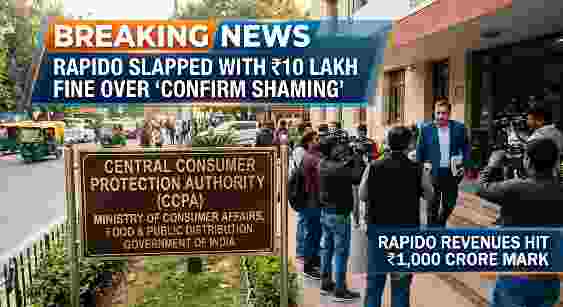
Rapido Slapped With ₹10 Lakh Fine Over ‘Confirm Shaming’ as Revenues Hit ₹1,000 Crore Mark
- Editor
- September 17, 2026
- Uncategorized
- 0 Comments
NEW DELHI — In a major regulatory crackdown on the ride-hailing sector, the Central Consumer Protection Authority (CCPA) has imposed a ₹10 lakh penalty on Rapido (Roppen Transportation Services Pvt Ltd) for utilizing manipulative user interface designs, commonly known as “dark patterns.”
Despite the regulatory heat, Rapido’s balance sheet paints the picture of a rapidly growing unicorn. The Bengaluru-based startup recently crossed a massive financial milestone, breaching the ₹1,000 crore total income mark for the fiscal year 2025 (FY25).
Here is a detailed breakdown of the regulatory action and the financial reality behind the ride-hailing giant.
Segment 1: The Regulatory Crackdown on “Confirm Shaming”
The ₹10 lakh fine stems from a sector-wide CCPA investigation into advance tipping and dynamic pricing models used by cab and bike-taxi aggregators. The consumer watchdog found Rapido guilty of multiple violations, primarily focusing on two specific dark patterns:
- Confirm Shaming: When a user booked a ride at the initial quoted fare, the app allegedly paused the booking and prompted them to voluntarily add extra money (₹10, ₹20, or ₹30) as a “tip” to secure a driver faster. The CCPA noted that the app displayed messages like, “Higher the price, higher the chance of getting a ride” or “Captains aren’t accepting at ₹60. Try adding +10, +20, +30.” The regulator ruled that this created a false sense of urgency and preyed on the consumer’s fear of not getting a ride, effectively strong-arming them into paying more after they had already committed to the original fare.
- Interface Interference: The CCPA also scrutinized Rapido’s “Set your price” slider. The regulator found that the UI was heavily skewed to encourage higher payments. Increasing the offer price triggered positive green text (“higher chance of getting a ride”), while lowering the price triggered red or orange warnings. Furthermore, the slider offered more physical space on the screen to increase the fare than to decrease it.
The CCPA firmly rejected Rapido’s defense that these features represented “real-time negotiation” between riders and drivers, noting that the Motor Vehicle Aggregator Guidelines mandate that tipping features can only be introduced after a ride is completed.
Segment 2: The “Cost of Doing Business”?
While the company claims to have removed the offending functionalities from its application, industry analysts point out a glaring discrepancy between the fine and the financial reality of the business model.
A ₹10 lakh penalty is viewed by many as a mere slap on the wrist for a unicorn operating at scale. If manipulative UI tactics succeed in convincing even a fraction of millions of daily users to voluntarily inflate their fares by ₹10 to ₹30, the resulting revenue surge far outweighs the regulatory fine. Critics argue that until penalties scale with revenue, such fines may simply be absorbed as the “cost of doing business.”
Segment 3: A Financial Juggernaut in FY25
Despite the controversy surrounding its pricing interface, Rapido’s underlying business is booming. According to consolidated financial statements accessed via Tofler:
- Massive Revenue Growth: Rapido’s operating revenue surged by 44% to reach ₹934 crore in FY25, up from ₹648 crore in the previous fiscal year. Total income breached the historic ₹1,000 crore milestone.
- Shrinking Losses: The company has also demonstrated significant operational leverage. Net losses were trimmed by 30%, falling from ₹370 crore in FY24 to ₹258 crore in FY25.
The Bottom Line
Rapido’s dual narrative is emblematic of India’s fast-paced gig economy. On one hand, the startup is successfully scaling its operations, trimming losses, and driving massive revenue growth. On the other hand, aggressive monetization strategies are increasingly putting these platforms in the crosshairs of consumer protection watchdogs. As the CCPA expands its ongoing investigations into industry rivals like Uber and Ola, the battle line between optimized revenue generation and consumer protection in the app economy has been clearly drawn.