OYO Prepares for IPO, Delhi Revamps EV Policy, and Real Estate Hits 3-Year Low
- Editor
- July 15, 2026
- Uncategorized
- 0 Comments
New Delhi, July 2026 — India’s corporate and retail landscapes are bracing for massive structural shifts following a wave of regulatory overhauls, real estate slowdowns, and agricultural delays. From a clean hospitality IPO to aggressive green-energy policies, the country’s economic gears are shifting rapidly.
The ₹6,650 Crore Debt Gamble: OYO’s Clean IPO Route
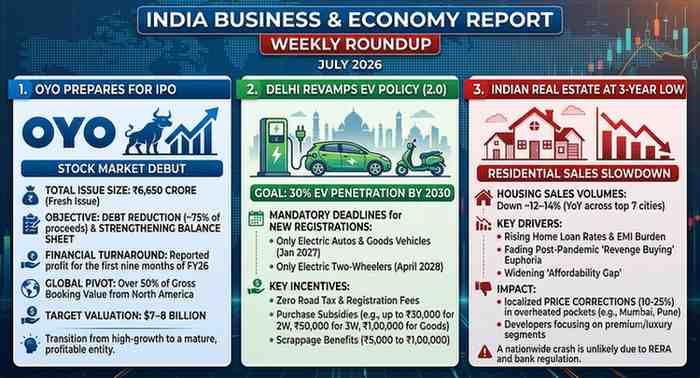
Hospitality unicorn OYO is finally launching its highly anticipated Initial Public Offering (IPO) with a ₹6,650 crore fresh issue. Crucially, the public offering contains no Offer for Sale (OFS), meaning early backers are not cashing out. Instead, the company plans to inject ₹4,987 crore directly into wiping out its debt.
While OYO turned the corner by reporting a ₹748 crore profit for the first nine months of FY26, its balance sheet remains weighed down by over ₹1,000 crore in annual financing costs. By using public funds to clear its loans, the company hopes to sharply lower its cost of capital and artificially accelerate its future profit margins.
The Property Glut: Supply Rises as Buyers Vanish
India’s residential real estate sector just wrapped up its worst three-month sales stretch in three years. Plummeting numbers in the April–June quarter show that a whopping 48% of all property transactions were concentrated entirely in just two hubs: Mumbai and Bengaluru.
While secondary markets like Pune saw a sharp 15% year-on-year sales decline, developers kept building, driving new housing launches up by 7%. This creates a steep supply-and-demand mismatch. Property dealers continue to tell buyers that “inventory is low” while telling sellers that “buyers are missing,” effectively stalling price corrections for the average consumer.
Delhi’s EV Mandate: Buying Drivers with Subsidies
The Delhi government has formally approved a highly aggressive Electric Vehicle (EV) Policy designed to phase out fossil-fuel vehicles by force. Under the new rules, the registration of petrol and CNG two-wheelers will be banned from April 1st, while electric auto-rickshaws become entirely mandatory by January 1st.
To sweeten the transition, the state is deploying a massive ₹15,000 crore war chest over four years. Car buyers will get a 100% road tax and registration waiver on EVs priced under ₹30 lakh. Meanwhile, two-wheeler buyers are being offered up to ₹60,000 in direct cash incentives spread across three years, alongside a ₹1 lakh scrap bonus for upgrading older four-wheelers.
The Monsoon Deficit: Kharif Sowing Plummets 23%
A severe delay in the monsoon season has triggered an agricultural crisis, with overall Kharif crop sowing crashing by 23%. Farmers facing dry fields have been forced to push back planting schedules, resulting in severe supply deficits across foundational crops. Pulse cultivation is currently down 30%, oilseeds have plummeted by 53%, and cotton has shrunk by 34%. Economists warn that if the rain deficit persists, this agricultural standstill will drag down India’s broader GDP growth.
Bottom Line
From corporate boardrooms using IPOs to run away from high debt, to local governments offering cash incentives to force EV adoption, India’s current economic momentum is being artificiality propped up by heavy policy interventions. With real estate sales freezing and the monsoon threatening food supply lines, the real test will be whether underlying consumer demand can sustain itself when the subsidies and credit lines run dry.