How Oil Supply Disruptions at Strait of Hormuz Could Raise Indian Household Costs and Inflation
- admin
- April 19, 2026
- Uncategorized
- 0 Comments
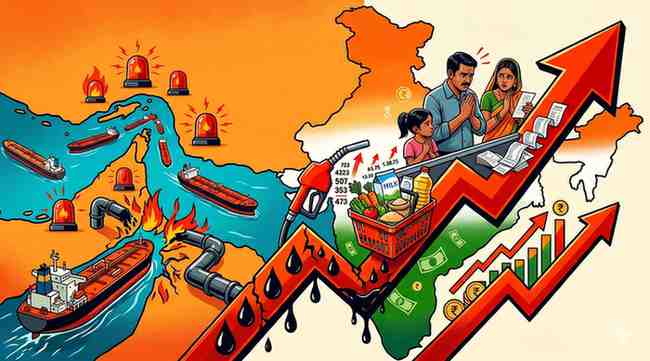
Geopolitical tensions threatening oil flows through the Strait of Hormuz pose direct risks to Indian household budgets, given India’s 85% dependence on crude imports and the commodity’s downstream impact on transport, food, and manufactured goods. A sustained $10 per barrel increase in crude prices could add 40-50 basis points to headline inflation within two quarters, forcing both monetary policy recalibration and potential fiscal intervention through excise adjustments.
New Delhi, April 2025 — The Strait of Hormuz, a 33-kilometre chokepoint through which roughly 20% of global oil supply transits daily, remains India’s most consequential external economic vulnerability. Approximately 60% of India’s crude imports originate from Gulf nations whose shipments traverse this waterway, creating a direct transmission mechanism between Middle Eastern geopolitics and the price of cooking gas, auto fuel, and fertiliser inputs that shape Indian household finances.
Why Does the Strait of Hormuz Matter to Indian Consumers?
India imported 4.7 million barrels of crude oil per day in fiscal 2024-25, making it the world’s third-largest oil consumer behind China and the United States. The petroleum value chain in India influences prices across sectors far beyond direct fuel consumption — transport costs affect vegetable prices, petrochemical feedstock determines plastic and packaging costs, and aviation turbine fuel drives airfare inflation. Indian households allocate approximately 6-8% of monthly expenditure to transport and fuel, a share that rises significantly for lower-income groups dependent on kerosene and LPG.
What Happens to Indian Inflation When Oil Prices Spike?
Reserve Bank of India research estimates that every 10% increase in crude oil prices adds approximately 30 basis points to wholesale price inflation and 20 basis points to consumer price inflation over a six-month horizon. The pass-through mechanism operates through both direct channels — petrol, diesel, LPG prices — and indirect channels including freight costs embedded in food and manufactured goods. Historical precedent from the 2022 Russia-Ukraine shock demonstrated this transmission clearly, when CPI inflation breached 7% and forced a 250 basis point rate hiking cycle.
How Does the Government Typically Respond to Oil Shocks?
Indian policymakers possess limited but meaningful tools to cushion oil price volatility. The excise duty buffer created during 2020’s price collapse provided approximately ₹8-10 per litre of adjustment headroom, though much of this was utilised during 2022. Strategic petroleum reserves at Visakhapatnam, Mangalore, and Padur hold roughly 5.3 million tonnes — approximately 9.5 days of import cover — insufficient for prolonged supply disruptions but useful for short-term price smoothing.
- India imports 85% of its crude oil requirements, with 60% sourced from Gulf Cooperation Council nations
- The Strait of Hormuz handles approximately 17-18 million barrels of oil daily, representing one-fifth of global consumption
- Crude oil prices above $85 per barrel typically push India’s current account deficit beyond the 2.5% of GDP comfort threshold
- Every ₹1 per litre reduction in central excise duty costs the exchequer approximately ₹14,000 crore annually
- Fertiliser subsidy bills expand by ₹4,000-5,000 crore for every $10 increase in natural gas prices
What Should Indian Businesses and Investors Monitor?
Corporate India faces differentiated exposure to Hormuz-linked disruptions. Aviation, logistics, and paint companies carry direct input cost sensitivity, while oil marketing companies face margin compression if retail price revisions lag crude movements. Conversely, upstream producers like ONGC and oil-services firms benefit from elevated realisations. Fixed-income investors should watch for RBI commentary linking external risks to the inflation trajectory, particularly any deviation from the current accommodative stance.
Analyst’s View
The structural vulnerability of Indian household finances to Gulf energy security will persist until India’s renewable capacity and electric vehicle penetration reach critical mass — likely a decade-long transition. Near-term, the April-June quarter typically represents peak refinery maintenance in the Gulf, creating seasonal price pressures even without geopolitical escalation. Investors and policymakers should treat any Hormuz-related disruption exceeding 72 hours as a trigger for defensive positioning, given the rapid transmission to Indian inflation expectations and bond yields.