How India’s Strategic Autonomy Doctrine Is Reshaping Global Alliance Structures
- admin
- April 26, 2026
- Uncategorized
- 0 Comments
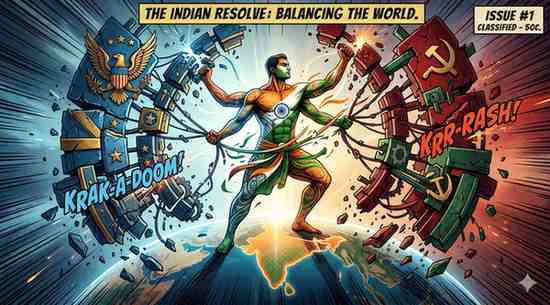
India’s commitment to strategic autonomy is emerging as a distinct geopolitical model that allows New Delhi to maintain partnerships with competing power blocs without formal alignment. This approach positions India as a critical swing state in the evolving multipolar order, enabling selective engagement with the United States, Russia, and China based on issue-specific national interests.
New Delhi, April 2025 — India’s foreign policy establishment is operationalising strategic autonomy as its core doctrine amid intensifying great power competition, marking a departure from Cold War-era non-alignment toward active multi-alignment. The NatStrat analysis underscores how New Delhi is leveraging its demographic weight, economic trajectory, and geographic position to extract maximum concessions from all major powers simultaneously.
What Is Driving India’s Strategic Autonomy Approach?
India’s strategic autonomy doctrine stems from structural shifts in the global order that have created space for middle powers to exercise independent agency. The United States requires Indian cooperation to counterbalance China in the Indo-Pacific, while Russia depends on Indian defence purchases to sustain its arms industry under Western sanctions. China, despite border tensions, recognises India’s potential role in alternative financial architectures like BRICS. This triangular dependency grants New Delhi unusual leverage that formal alliance membership would constrain.
What Does This Mean for India’s Foreign Policy?
India’s multi-alignment strategy allows simultaneous participation in the Quad security dialogue and the Shanghai Cooperation Organisation without perceived contradiction. New Delhi continues purchasing discounted Russian crude oil while expanding defence technology partnerships with Washington. The Ministry of External Affairs has institutionalised this approach through bilateral frameworks that avoid mutual defence obligations, preserving decision-making flexibility during potential flashpoints in Taiwan or Ukraine.
How Does India’s Position Compare Globally?
India’s strategic autonomy model differs fundamentally from traditional neutrality practiced by Switzerland or Cold War non-alignment championed by Nehru. Unlike ASEAN hedging strategies, India actively shapes regional security architecture through initiatives like the International Solar Alliance and Coalition for Disaster Resilient Infrastructure. The last time a rising power maintained comparable equidistance was arguably Bismarckian Germany in the 1870s, though India operates within democratic constraints that 19th-century Prussia lacked.
- India maintains defence agreements with over 30 countries while avoiding formal mutual defence treaties with any power
- Russian arms constitute approximately 60% of Indian military equipment, though this share declined from 85% in 2010
- India-US bilateral trade reached $190 billion in 2024, compared to $118 billion in India-China trade despite border hostilities
- New Delhi participates in five of the seven major multilateral groupings involving either Washington or Beijing
- Indian foreign exchange reserves exceeding $650 billion provide economic buffer against coercive diplomacy from any single power
What Should Policymakers and Investors Watch?
The sustainability of strategic autonomy depends on India maintaining credible partnerships without dependency on any single power. Investors should monitor defence indigenisation progress under Atmanirbhar Bharat, which determines how quickly India can reduce Russian equipment reliance. Technology transfer agreements with the United States in jet engines and semiconductors will signal Washington’s willingness to treat New Delhi as a genuine partner rather than a transactional ally.
Analyst’s View
India’s strategic autonomy will face its sternest test if forced to choose sides during a Taiwan contingency or further Russia-NATO escalation. The doctrine works precisely because no power has yet demanded explicit alignment. New Delhi’s diplomatic bandwidth will be consumed by managing expectations across competing capitals while extracting technology, investment, and market access from each. Watch for India’s voting patterns at the United Nations Security Council and arms procurement diversification toward European and Israeli suppliers as leading indicators of doctrinal stress.