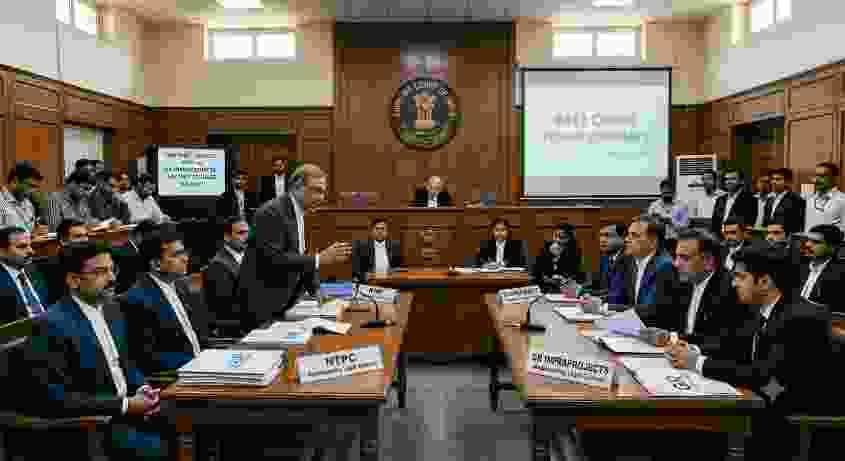
High-Stakes Power Struggle: NTPC and GR Infraprojects Lock Horns in ₹413 Crore Battery Contract War
- Editor
- September 21, 2026
- Uncategorized
- 0 Comments
New Delhi, September 2026 — A high-voltage corporate collision has erupted between state-owned power giant NTPC and infrastructure major GR Infraprojects (GRIL) over a massive ₹413.37 crore Battery Energy Storage System (BESS) contract.
What began as a critical green energy infrastructure project at the Mouda Super Thermal Power Station in Maharashtra has swiftly transformed into a bitter contractual slugfest, complete with mutual termination claims, multi-crore security encashments, and the looming shadow of a prolonged legal battle.
The Anatomy of the Deal: Why BESS Matters
As India pushes aggressively toward green energy integration, power grids require massive storage solutions to balance intermittent renewable generation.
- The Project: NTPC awarded the multi-hundred-crore contract to GRIL to design, build, and deploy advanced battery energy storage systems intended to stabilize power output at the Mouda thermal facility.
- The Financial Stakes: In mega-infrastructure contracts of this scale, developers are required to lock in financial security guarantees. NTPC held a substantial ₹91 crore security deposit to protect against sudden default or mid-project abandonment, a standard insurance policy to prevent catastrophic supply chain delays for critical national infrastructure.
The Great Exit Clash: Force Majeure vs. Contractor Default
The friction turned explosive when both companies rushed to officially terminate the contract, pointing fingers at vastly different legal justifications:
- GRIL’s Defense (Force Majeure): GR Infraprojects moved to terminate the agreement, citing unforeseen global disruptions, ongoing geopolitical conflicts, and extreme “force majeure” market conditions that made project execution unviable. Under force majeure clauses, contractors typically seek a clean exit alongside the return of their financial securities.
- NTPC’s Counter-Strike (Contractor Default): NTPC fiercely rejected GRIL’s narrative, asserting that the contract was terminated due to severe contractor default, poor service delivery, and failure to meet performance benchmarks.
Rather than letting GRIL walk away scot-free, NTPC immediately exercised its institutional leverage, confiscating and encashing the entire ₹91 crore security deposit. Furthermore, NTPC announced plans to fast-track a fresh tender to re-award the storage project to a new vendor.
The Legal War Room: A ₹91 Crore Showdown
Corporate legal experts note that this battle is far from over. The core of the impending litigation will hinge on the legitimacy of the force majeure claim:
- If courts or arbitration panels validate GRIL’s geopolitical and supply chain disruption arguments, NTPC could be legally forced to disgorge and return the ₹91 crore security pool.
- Conversely, if NTPC successfully establishes chronic underperformance and default, the state-run power titan keeps the cash and leaves GRIL facing steep financial and reputational damages.
Bottom Line
The collision between NTPC and GR Infraprojects highlights the volatile realities of executing green energy and storage mega-projects amid global supply chain turbulence. With a ₹91 crore security deposit frozen in dispute and a fresh tender already in motion, this multi-crore corporate clash is set to become one of the most closely watched legal battles in India’s infrastructure sector.