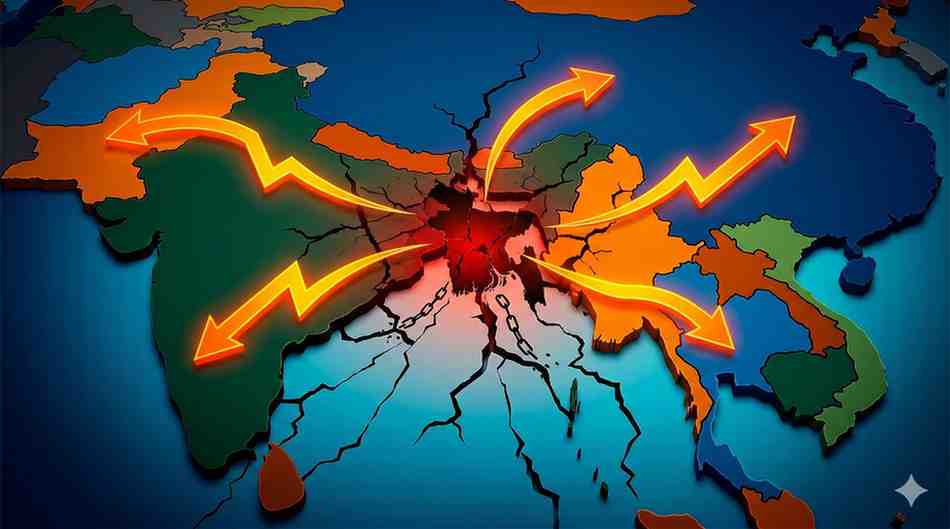
Bangladesh’s Diplomatic Isolation Exposes Strategic Vulnerabilities as Regional Realignment Accelerates
- admin
- April 19, 2026
- Uncategorized
- 0 Comments
Bangladesh faces mounting evidence of foreign policy dysfunction as the interim government struggles to maintain balanced relationships with major powers while navigating domestic political instability. The crisis reveals how decades of transactional diplomacy without institutional depth has left Dhaka exposed during a period of intensifying great-power competition in South Asia.
New Delhi, April 2025 — A new assessment has characterised Bangladesh’s current diplomatic posture as effectively bankrupt, pointing to the interim administration’s inability to secure meaningful international support during ongoing governance challenges. The critique gains weight against the backdrop of strained relations with India, uncertain engagement with China, and diminished leverage with Western capitals that once championed Bangladesh’s democratic credentials.
What Is Driving Bangladesh’s Diplomatic Crisis?
Bangladesh’s foreign policy architecture was built primarily around the personal networks of Sheikh Hasina’s government over fifteen years of uninterrupted rule. The August 2024 political upheaval that installed Muhammad Yunus’s interim administration severed these institutional relationships without establishing replacement frameworks. Dhaka’s diplomatic corps finds itself navigating hostile territory with neither the political capital accumulated by the previous regime nor fresh mandates from democratic legitimacy. The situation marks the most significant foreign policy vacuum Bangladesh has experienced since the post-1975 military governments struggled to rebuild international standing.
What Does This Mean for India?
India faces a deteriorating strategic environment along its eastern flank as Bangladesh’s policy drift creates space for competing influences. New Delhi’s substantial investments in connectivity projects, including the India-Bangladesh Friendship Pipeline and multimodal transit agreements, face implementation uncertainty. The Hindu minority population in Bangladesh has reported increased vulnerabilities, creating domestic political pressure on the Indian government to adopt harder positions. India’s neighbourhood-first policy confronts its most significant test since the 2015 Nepal blockade crisis demonstrated the limits of coercive diplomacy.
How Are External Powers Positioning Themselves?
China has maintained calculated engagement with the interim government, protecting its existing infrastructure investments while avoiding overcommitment during political uncertainty. The United States, which initially welcomed the end of Hasina’s increasingly authoritarian rule, now confronts the consequences of its democracy-promotion rhetoric meeting South Asian realities. Gulf states, particularly Saudi Arabia and the UAE, have emerged as alternative diplomatic anchors for Dhaka, offering economic lifelines without governance conditionalities.
- Bangladesh’s foreign exchange reserves have declined to approximately USD 20 billion, down from USD 48 billion at peak levels in 2021
- Bilateral trade with India exceeded USD 15 billion annually under the previous government, with transit arrangements worth an estimated USD 1 billion
- Chinese investment commitments in Bangladesh total approximately USD 26 billion across Belt and Road Initiative projects
- Remittances from Gulf countries constitute roughly 60% of Bangladesh’s USD 21 billion annual diaspora inflows
- The interim government has been in power for approximately eight months without announcing a clear election timeline
What Should Regional Observers Watch?
Bangladesh’s ability to service existing international commitments, particularly infrastructure loans from China and Japan, will signal whether economic constraints force diplomatic capitulation. The treatment of bilateral agreements signed under the Hasina government—especially the Teesta water-sharing framework discussions—will indicate whether Dhaka pursues continuity or rupture. Domestic political stabilisation timelines remain the critical variable, as foreign partners require credible counterparts for meaningful engagement.
Analyst’s View
Bangladesh’s diplomatic exposure represents a structural vulnerability rather than a temporary crisis. The country’s foreign policy establishment never developed the institutional autonomy to survive political transitions, leaving it dependent on regime-specific relationships that evaporated overnight. The next twelve months will determine whether Dhaka can rebuild credible international partnerships before economic pressures or domestic instability foreclose options entirely. Regional observers should monitor three indicators: the pace of IMF programme negotiations, the status of Indian transit agreements, and any formal election timeline announcement. Bangladesh’s trajectory will shape South Asian strategic calculations for the remainder of this decade.