The 100% Tariff Sword: How Washington’s New Energy Sanctions Law Threatens India and Global Trade
- Editor
- September 21, 2026
- Uncategorized
- 0 Comments
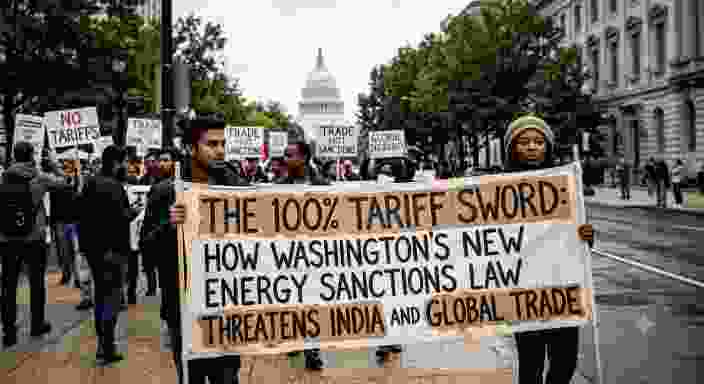
New Delhi / Washington, September 2026 — The passage of the Sanctioning Russia and Iran Act has handed the White House an unprecedented economic weapon: the legal authority to slap up to 100% tariffs on major economies that continue purchasing petroleum from Moscow and Tehran.
What Washington frames as a strategic enforcement of global sanctions, international markets view as a loaded geopolitical gun pointed directly at heavy energy importers like India and China.
Decoding the Law: A Power to Threaten, Not Just Impose
Passed by overwhelming congressional majorities and signed into law on September 18, 2026, the legislation creates a sweeping secondary sanctions framework.
- The Mechanics of the Act: The text explicitly grants Washington the power to levy up to 100% punitive tariffs on countries buying Russian or Iranian oil.
- The Legislative Nuance: Internet headlines quickly sparked panic by claiming a 100% tariff had already been slapped on India. In reality, the law establishes that tariffs can be imposed, giving the administration a formidable weapon of coercion rather than an immediate blanket ban.
The Grand Global Energy Strategy
To understand why Washington has enacted this legislation, market analysts point to a broader, aggressive US master plan to reshape global energy supply chains:
- Venezuela Secured: The US intervention in Venezuela targeted a major sovereign oil player, bringing its production infrastructure back under Western influence to supply global markets.
- Moscow Isolated: Ongoing Western sanctions have sought to choke off Russian energy exports to independent buyers.
- Middle East Friction: Persistent geopolitical tensions in the Middle East ensure that regional oil flows remain constrained, keeping alternative supplies unpredictable.
By squeezing supply chains across the globe, the US strategy funnels the world away from traditional oil hubs, positioning American energy markets as the ultimate alternative.
Can Green Energy and Alternatives Rescue India?
As Washington tightens the screws on traditional oil imports, emerging economies face a tough choice. While the global push toward renewables—such as solar, wind, and electric vehicles (EVs)—is accelerating, transitioning a massive developing economy is easier said than done.
- The EV and Ethanol Reality: While countries like China have aggressively transitioned toward EVs, nations like India have struggled to see immediate relief from alternative fuel policies like ethanol blending, which have failed to significantly lower domestic fuel prices.
- The Nuclear Alternative: Some analysts suggest that accelerating small modular nuclear reactors via private sector investment could fast-track electrification and power EV adoption. However, navigating bureaucratic red tape and democratic policy delays makes overnight execution virtually impossible.
Will Washington Actually Risk Poking New Delhi?
Despite the terrifying optics of a 100% tariff threat, seasoned trade experts believe a direct trade war with India is unlikely. India remains an indispensable strategic counterweight in the Indo-Pacific and a massive consumer market.
Instead, the legislation serves primarily as an uncomfortably sharp negotiation lever—a tool for the White House to twist arms, extract diplomatic concessions, and pressure New Delhi into shifting its energy allegiance away from sanctioned suppliers.
Bottom Line
The Sanctioning Russia and Iran Act is not just about penalizing foreign actors; it is about rewriting the rules of global commerce under the threat of economic annihilation. While no tariffs have been officially triggered yet, the sword is unsheathed, leaving emerging economies walking a geopolitical tightrope between energy security and Western retaliation.