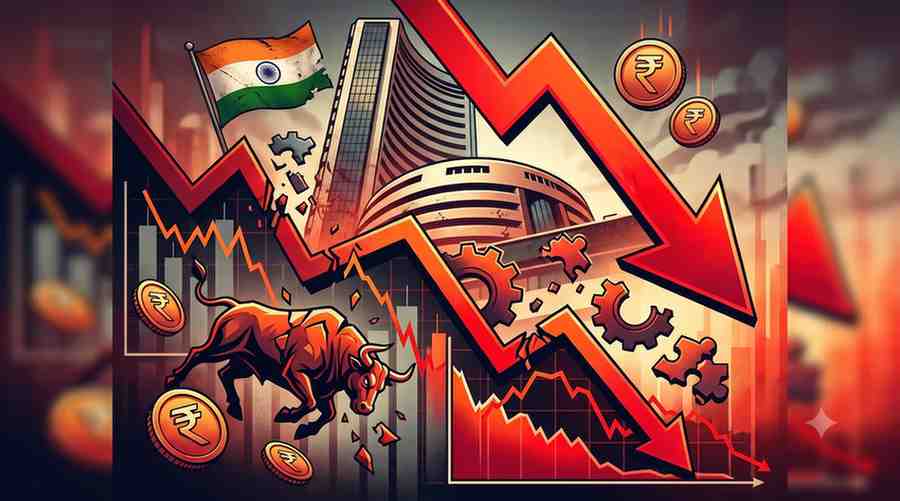
Understanding the Drivers Behind the Recent Decline in Indian Markets
The recent decline in Indian markets is primarily driven by a combination of disappointing corporate earnings, rising global interest rates, and geopolitical tensions. These factors have collectively undermined investor confidence, prompting a sell-off.
New Delhi, August 2026 — Indian stock indices experienced a notable drop today, with the Nifty 50 shedding 2.5% and the Sensex losing 800 points. This significant downturn can be attributed to a confluence of factors impacting investor sentiment and market dynamics.
What Is Driving This?
Corporate earnings reports have indicated weaker-than-expected performance among major sectors, particularly in IT and banking, which comprise a substantial portion of the market. Rising global interest rates have also pressured equity valuations, leading to a flight to safety among investors. Furthermore, geopolitical tensions, particularly in the Asia-Pacific region, are inducing volatility, causing uncertainty in investment decisions. The cumulative effect of these elements has led to a more cautious market environment.
What Does This Mean for India?
The market decline has broader implications for the Indian economy, particularly in terms of consumer sentiment and business investment. The slowdown in equity markets may lead companies to reassess expansion plans and capital expenditure, potentially stymying economic growth. Policymakers may find themselves under pressure to implement measures that stimulate both consumer confidence and investment flows to stabilize the financial landscape. The Reserve Bank of India may also need to reconsider its stance on interest rates in light of these developments.
How Does This Compare Globally?
The Indian market’s decline mirrors trends in other emerging markets, where investors are similarly reacting to rising interest rates and geopolitical risks. For instance, markets in Brazil and Turkey have also experienced sell-offs, reflecting a global shift in capital towards safer assets. In contrast, developed markets such as the U.S. have shown resilience, primarily due to stronger corporate earnings and consumer spending, highlighting a divergence in recovery trajectories between emerging and developed economies.
- Indian markets saw a drop of 2.5% today, marking the largest one-day decline in six months.
- Corporate earnings growth for Q2 has slowed to 5%, below expectations of 10%.
- Global interest rates have risen to their highest levels in over a decade, influencing investment flows.
- Geopolitical tensions, particularly surrounding Taiwan, have increased market volatility.
- Foreign institutional investors have withdrawn approximately $1 billion from Indian equities in the past month.
Analyst’s View
The decline in Indian markets signals a potential inflection point for both investors and policymakers. Stakeholders should closely monitor corporate earnings and economic indicators in the coming months to gauge the persistence of this downturn. As global interest rates remain elevated, Indian markets may continue to experience pressure unless domestic economic indicators show signs of resilience. Investors are advised to adopt a cautious approach, focusing on sectors likely to withstand external shocks while keeping an eye on potential policy responses aimed at stabilizing the market.