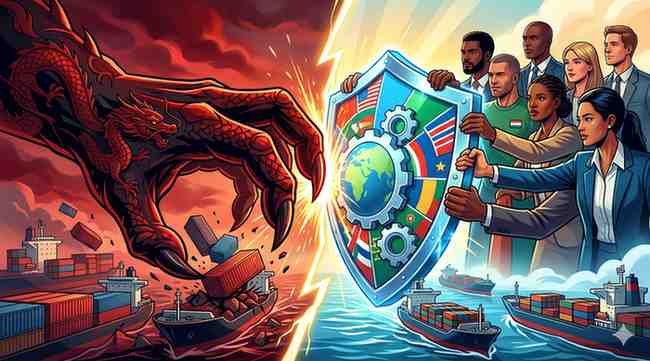
Beijing’s Economic Coercion Playbook Faces Diminishing Returns as Trade Partners Build Resilience
- admin
- April 21, 2026
- Uncategorized
- 0 Comments
China’s frequent deployment of economic penalties against trading partners is generating strategic blowback, as targeted nations increasingly coordinate countermeasures and diversify supply chains away from Chinese dependence. Beijing’s coercive economic toolkit—once devastatingly effective—now risks accelerating the very decoupling it seeks to prevent.
New Delhi, April 2025 — China’s willingness to weaponise trade relationships has become a defining feature of its foreign policy arsenal, yet mounting evidence suggests this strategy is approaching a point of diminishing returns. From rare earth export restrictions against Japan in 2010 to the sweeping trade measures against Australia in 2020-21, Beijing has repeatedly demonstrated its capacity to inflict economic pain on nations that cross perceived red lines—but the cumulative effect has been to galvanise collective resistance rather than compliance.
What Is Driving China’s Economic Coercion Strategy?
Beijing views economic leverage as a lower-risk alternative to military confrontation, particularly in disputes involving territorial claims, technology transfer, and diplomatic recognition of Taiwan. China’s position as the world’s largest trading nation and dominant processor of critical minerals provides substantial coercive capacity. The strategy assumes that target economies, facing immediate commercial losses, will pressure their governments toward accommodation. This calculus worked effectively when China’s market access appeared irreplaceable and when targeted nations stood isolated.
Why Is This Approach Now Generating Backlash?
The frequency of China’s economic penalties has transformed isolated incidents into a recognisable pattern that trade partners now actively hedge against. Australia’s experience proved instructive—despite Beijing blocking coal, wine, barley and lobster exports worth billions, Canberra found alternative markets and refused policy concessions. Lithuania withstood Chinese pressure over Taiwan ties by securing EU solidarity mechanisms. The predictability of China’s coercive responses has paradoxically enabled pre-emptive diversification strategies across multiple economies.
What Does This Mean for India?
India occupies a unique position in this shifting landscape, having already implemented significant restrictions on Chinese investment and digital platforms following the 2020 Galwan Valley confrontation. Indian policymakers have accelerated production-linked incentive schemes precisely to reduce dependence on Chinese manufacturing inputs. The pharmaceutical sector exemplifies this vulnerability—India sources approximately 68% of active pharmaceutical ingredients from China. New Delhi’s experience suggests that proactive decoupling, while economically costly in the short term, provides strategic autonomy that reactive responses cannot achieve.
- China deployed formal or informal trade restrictions against 27 countries between 2010 and 2024, according to the Australian Strategic Policy Institute
- Australia’s total exports actually increased 8% during 2020-22 despite Chinese restrictions, as commodities found alternative buyers
- The EU’s Anti-Coercion Instrument, operational since December 2023, specifically enables collective retaliation against economic bullying
- China controls 60% of rare earth mining and 90% of processing capacity—a concentration that Japan, the US and EU are now actively working to dilute
- India-China bilateral trade reached $118.4 billion in 2024, with India’s deficit exceeding $85 billion, underscoring persistent structural dependence
How Are Global Institutions Responding?
Multilateral frameworks are slowly adapting to address economic coercion as a distinct challenge. The G7’s Coordination Platform on Economic Coercion represents a nascent attempt at collective defence mechanisms. World Trade Organization rules, designed for an era of tariff disputes, remain inadequate for addressing informal boycotts and regulatory harassment that characterise modern economic statecraft. The absence of clear legal definitions allows Beijing to maintain plausible deniability while partner nations struggle to mount coordinated responses within existing institutional architectures.
Analyst’s View
China faces a strategic paradox: the very effectiveness of economic coercion in individual cases has undermined its long-term utility by signalling unreliability as an economic partner. Watch for three indicators in the coming quarters—the pace of critical mineral processing capacity expansion in allied nations, the depth of India-EU-US coordination on supply chain resilience, and whether Beijing moderates its approach toward the Philippines amid ongoing South China Sea tensions. The calculus for Chinese policymakers has shifted fundamentally: each new instance of economic punishment now carries compounding reputational costs that may exceed the tactical gains. Nations with diversified trade portfolios increasingly treat Chinese market access as a risk factor rather than an unalloyed opportunity.