The Impact of Political Turmoil on UP’s Development Agenda: Who Benefits?
- admin
- December 25, 2025
- Uncategorized
- 0 Comments
Balancing Development Amidst Political Instability
Uttar Pradesh, India’s most populous state, is at the center of a transformative economic and infrastructural push. The state’s record budget for 2024-2025 reflects its ambitious goals to propel development across various sectors. However, recurring political turbulence raises questions about the efficiency and continuity of these efforts. While development agendas promise progress, the disruptions caused by political instability often derail their execution. The crucial question is: Who stands to gain from this instability, and at what cost?
Development in Focus: Uttar Pradesh’s 2024-2025 Budget
The state’s budget for 2024-2025, announced by Finance Minister Suresh Kumar Khanna, is the largest in its history, with an outlay of ₹7.36 lakh crore. It aims to boost infrastructure, agriculture, energy, and employment generation, showcasing a comprehensive approach to economic growth.
Key Allocations:
- Infrastructure: Major investments have been dedicated to projects such as the Ganga Expressway and the Delhi-Varanasi High-Speed Rail, with budgets exceeding ₹36,000 crore and ₹1.21 lakh crore, respectively.
- Agriculture: The budget includes ₹400 crore for new schemes to modernize and support farmers across the state.
- Energy: Plans are underway to increase the state’s power generation capacity to 31,500 MW by the end of the fiscal year, reflecting a commitment to sustainable energy solutions.
- Employment: An ambitious target of generating over 1.10 crore job opportunities within the state by 2025 underlines the focus on human capital development.
With such robust planning and resource allocation, Uttar Pradesh appears poised for significant growth. However, the impact of political instability on the execution of these initiatives cannot be ignored.
Political Turmoil and Its Impact on Development
Governance Disruptions
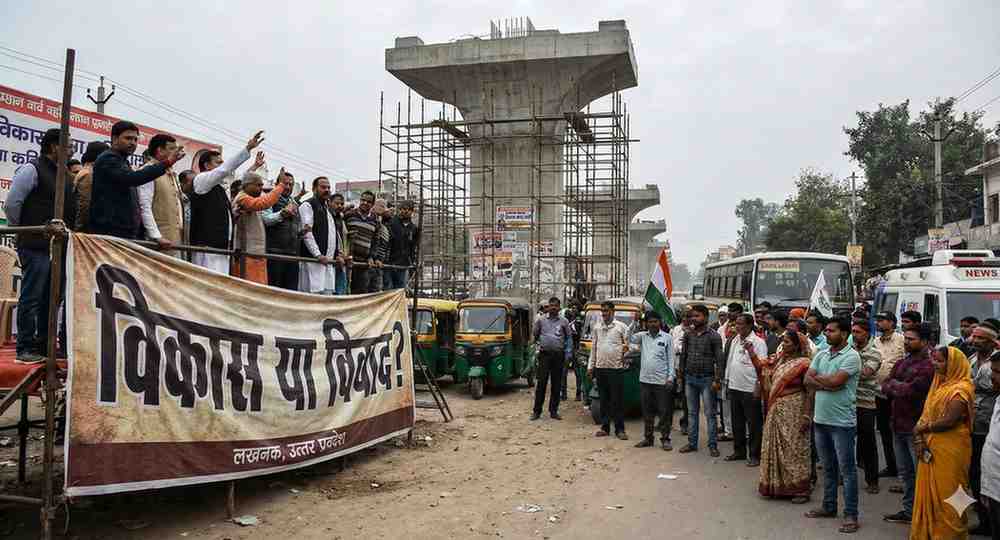
Political instability often leads to delays in decision-making and governance disruptions. Infrastructure projects like the Ganga Expressway, which promises to revolutionize connectivity in the state, face setbacks due to disputes over land acquisition and resource allocation. These delays stall progress and inflate project costs.
Policy Reversals
Frequent changes in political leadership often result in abrupt shifts in priorities. Policies initiated by one administration are frequently altered or abandoned by the next, leading to wastage of resources and eroding investor confidence. For instance, industrial zones and urban development projects risk becoming casualties of shifting political agendas.
Resource Diversion
Political volatility often leads to the diversion of funds toward populist schemes rather than long-term development initiatives. While such schemes may secure immediate political gains, they often come at the cost of infrastructure, healthcare, and education projects, which are crucial for sustained growth.
Beneficiaries of Political Instability
Political Elites
Political leaders and parties often leverage instability to consolidate power and redirect resources to strengthen their influence. This can result in projects being approved or stalled based on political considerations rather than public benefit.
Bureaucratic Stakeholders
In times of political uncertainty, bureaucrats often gain increased autonomy in decision-making. While this can sometimes ensure continuity, it also opens avenues for corruption and inefficiency.
Corporate Entities
Certain corporations exploit political instability to secure favorable contracts or policy concessions. Large infrastructure projects, such as the Noida International Airport, have been scrutinized for benefiting well-connected entities during periods of administrative flux.
Media and Advocacy Groups
Political turmoil attracts significant media attention, offering opportunities for advocacy groups and think tanks to influence public opinion. However, this often shifts focus away from critical issues like project delays and resource mismanagement.
Strategies for Sustainable Development
To shield development agendas from the adverse effects of political instability, Uttar Pradesh must adopt measures that ensure stability and transparency:
- Institutional Strengthening: Establishing autonomous bodies to oversee key projects can mitigate disruptions caused by political changes.
- Policy Continuity: Developing bipartisan agreements on major initiatives can ensure that critical projects remain unaffected by leadership transitions.
- Public Engagement: Encouraging citizen participation in monitoring development projects fosters accountability and ensures that resources are used effectively.
- Transparency in Budgeting: Regular audits and public disclosures of budget allocations can reduce the risk of resource mismanagement.
- Capacity Building: Strengthening the administrative machinery to handle project execution efficiently can minimize delays and enhance outcomes.
The Path Forward
While Uttar Pradesh’s development agenda for 2024-2025 is ambitious and comprehensive, its success hinges on maintaining political stability and fostering a governance framework that prioritizes public welfare over partisan gains. The state must strive to ensure that its development initiatives remain unaffected by political turbulence, thereby translating policy promises into tangible benefits for its citizens.
In the end, sustainable development is not just about ambitious budgets and grand projects but also about creating an ecosystem that empowers every stakeholder—citizens, businesses, and policymakers—to contribute meaningfully. Political turmoil may disrupt this balance, but with strategic measures, Uttar Pradesh can ensure that its development agenda stays on track, benefiting all rather than a select few.