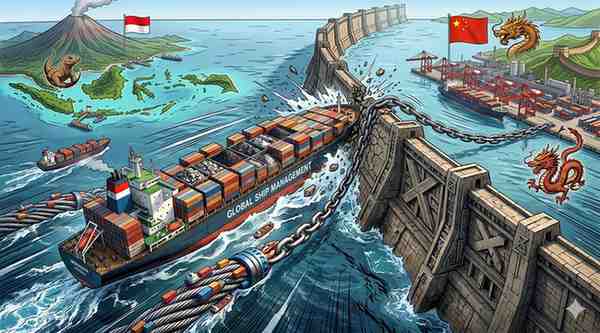
Why Indonesia’s Strategic Tilt Toward China Faces Structural Limits Despite Deepening Trade Ties
- admin
- April 28, 2026
- Uncategorized
- 0 Comments
Indonesia’s partnership with China, while economically significant, rests on fragile foundations shaped by maritime disputes, domestic political sensitivities, and Jakarta’s careful hedging strategy. The relationship’s durability will depend less on trade volumes than on Beijing’s willingness to accommodate Indonesian sovereignty concerns in the South China Sea.
New Delhi, April 2025 — Indonesia and China recorded bilateral trade exceeding $130 billion in 2024, yet this commercial interdependence masks deeper strategic fault lines that neither government publicly acknowledges. The partnership, often portrayed as a cornerstone of China’s Southeast Asian influence, operates under persistent structural tensions that make it fundamentally more fragile than headline figures suggest.
What Is Driving the Fragility in Indonesia-China Relations?
Indonesia’s relationship with China has always been transactional rather than transformational. Jakarta maintains strict non-alignment principles inherited from its founding Bandung Conference era, refusing to become a junior partner in any great power’s sphere of influence. Beijing’s expansive nine-dash line claims directly overlap with Indonesia’s exclusive economic zone around the Natuna Islands, creating an irreconcilable sovereignty dispute that periodically flares into naval standoffs. Indonesian domestic politics further complicates the relationship, as ethnic Chinese minorities remain politically sensitive following historical anti-Chinese violence, making any government appear too close to Beijing a potential electoral liability.
What Does This Mean for India’s Strategic Calculus?
India’s policymakers should recognise Indonesia as a potential partner in maintaining Indo-Pacific balance rather than assuming Jakarta will drift permanently into China’s orbit. New Delhi’s Act East policy and Indonesia’s Global Maritime Fulcrum strategy share overlapping interests in maritime security, supply chain diversification, and counterbalancing Chinese dominance. The Andaman and Nicobar Islands position India at the western gateway to the Malacca Strait, creating natural complementarities with Indonesian interests in securing the eastern approaches. Bilateral defence cooperation, including joint patrols and intelligence sharing, remains underdeveloped relative to strategic potential.
How Does Indonesia Compare to Other ASEAN States?
Indonesia occupies a unique position among Southeast Asian nations in its dealings with China. Unlike Cambodia or Laos, which have become functionally dependent on Chinese infrastructure financing, Indonesia maintains diversified economic partnerships with Japan, South Korea, the European Union, and increasingly India. The Philippines under President Marcos has shifted toward explicit American alignment, while Thailand and Vietnam calibrate more carefully between powers. Indonesia’s sheer size—270 million people and ASEAN’s largest economy—grants it leverage that smaller neighbours lack when negotiating with Beijing.
- Indonesia-China bilateral trade reached $139 billion in 2023, with Indonesia running a modest surplus
- Chinese investment in Indonesian nickel processing exceeded $15 billion between 2020-2024
- The Natuna Islands dispute has triggered at least seven documented naval confrontations since 2016
- Ethnic Chinese constitute approximately 3% of Indonesia’s population but control an estimated 70% of private corporate wealth
- Indonesia rejected joining China’s security initiatives while accepting Belt and Road infrastructure projects selectively
What Should Investors and Policymakers Watch?
Three indicators will signal whether the partnership strengthens or fractures in coming years. First, Indonesian naval procurement decisions—purchases from Western suppliers versus Chinese platforms—will reveal Jakarta’s true security alignment. Second, downstream nickel processing terms will show whether Indonesia can extract lasting value from Chinese capital or becomes locked into dependency. Third, any escalation in Natuna waters could rapidly politicise the entire relationship, as Indonesian nationalism remains easily mobilised against perceived Chinese encroachment.
Analyst’s View
Indonesia will continue extracting economic benefits from China while systematically hedging against strategic dependency—a posture that serves Jakarta’s interests but creates persistent uncertainty for Beijing’s regional ambitions. The partnership lacks the ideological glue or security alignment that characterises durable alliances, making it vulnerable to disruption from maritime incidents, domestic political shifts, or attractive alternatives offered by competing powers. For India, this fragility represents opportunity: sustained diplomatic investment in Jakarta could yield a consequential Indo-Pacific partner precisely because Indonesia seeks diversification away from excessive China exposure.