India’s BRICS Leadership Ambitions Face Identity Crisis as Bloc Struggles for Coherent Agenda
- admin
- April 18, 2026
- Uncategorized
- 0 Comments
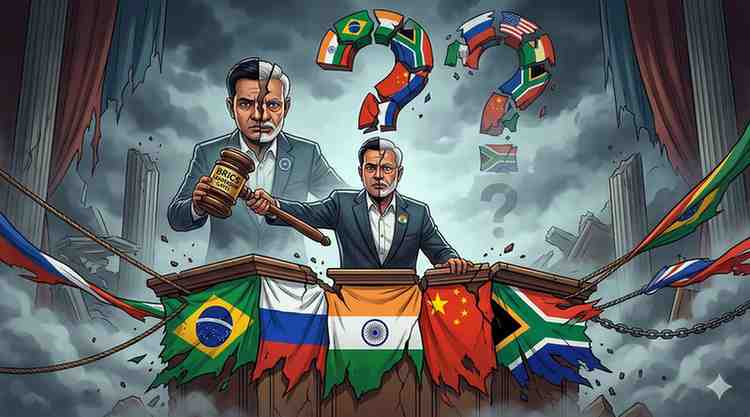
India faces a fundamental strategic dilemma in leading BRICS, a grouping whose expansion to nine members has diluted its original economic rationale without producing a clear alternative mission. New Delhi must now decide whether to champion the bloc as a genuine multilateral platform or accept its drift toward becoming a China-dominated counterweight to Western institutions.
New Delhi, April 2026 — India’s assumption of BRICS chairmanship arrives at a moment when the bloc’s existential purpose remains undefined, forcing New Delhi to navigate between competing visions of what a non-Western alliance should accomplish in an increasingly fractured global order.
What Is Driving BRICS’s Identity Crisis?
BRICS originated in 2009 as an economic concept grouping fast-growing emerging markets, but the 2024 expansion to include Iran, UAE, Ethiopia, and Egypt transformed it into something geopolitically ambiguous. The original thesis — that Brazil, Russia, India, China, and South Africa represented a convergent economic bloc — has collapsed under divergent growth trajectories and competing strategic interests. Russia’s war economy, China’s property-led slowdown, and South Africa’s stagnation bear little resemblance to India’s 6.5% growth momentum. BRICS now lacks the economic coherence that justified its creation.
What Does This Mean for India’s Strategic Position?
India confronts a zero-sum calculation within BRICS that mirrors its broader foreign policy tensions. Beijing views the expanded bloc as a platform for de-dollarisation and institutional alternatives to Western finance, while New Delhi remains wary of frameworks that enhance Chinese leverage. India’s trade deficit with China exceeded $85 billion in 2024-25, making economic decoupling rhetoric ring hollow within a supposedly cooperative bloc. The Quad partnership and deepening U.S. defence ties further complicate India’s positioning as a BRICS leader advocating non-Western solidarity.
How Does BRICS Compare to Other Multilateral Blocs?
BRICS lacks the institutional depth of established multilateral organisations, possessing neither binding treaty obligations nor enforcement mechanisms. The New Development Bank, BRICS’s primary concrete achievement, has disbursed approximately $33 billion since 2015 — a fraction of World Bank lending. ASEAN’s consensus-based model offers a precedent for diverse membership, but Southeast Asian nations share geographic proximity and integrated supply chains that BRICS members fundamentally lack. The G20, where India achieved notable diplomatic success in 2023, offers a more effective platform for emerging economy coordination.
- BRICS now represents 46% of global population and approximately 37% of global GDP at purchasing power parity
- Intra-BRICS trade accounts for less than 6% of members’ total trade volumes, indicating limited economic integration
- China’s economy is larger than all other BRICS members combined, creating inherent power asymmetries
- India-China bilateral relations remain frozen since the 2020 Galwan Valley clash, with 60,000+ troops deployed along the LAC
- The BRICS de-dollarisation agenda has produced no viable alternative currency mechanism despite years of discussion
What Should Policymakers and Investors Watch?
India’s chairmanship will be tested on whether New Delhi can advance concrete deliverables beyond summit communiqués. The proposed BRICS grain exchange and mutual credit rating agency remain in conceptual stages after years of negotiation. Foreign institutional investors should monitor whether India uses the platform to accelerate rupee internationalisation or whether Chinese yuan dominance in alternative payment systems undermines Indian interests. Corporate strategists must assess whether BRICS membership generates tangible market access benefits or remains primarily symbolic.
Analyst’s View
India’s BRICS leadership will likely prioritise damage limitation over transformative ambition, seeking to prevent the bloc from becoming an explicitly anti-Western vehicle while extracting marginal benefits from South-South rhetoric. The more consequential action lies elsewhere: India’s simultaneous deepening of Quad security cooperation, bilateral defence agreements with France and the United States, and aggressive pursuit of free trade agreements with the UK and EU suggest New Delhi views BRICS as one instrument among many rather than a defining strategic alignment. Watch for India to propose incremental, technically focused initiatives — digital public infrastructure sharing, climate finance mechanisms — that avoid the zero-sum framing Beijing prefers while demonstrating leadership capacity to the Global South.