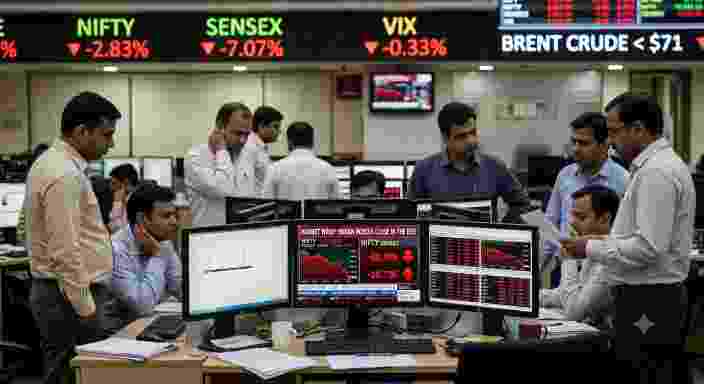
How Rising Oil Prices Could Derail India’s Growth Momentum: S&P Warning Explained
- admin
- April 18, 2026
- Uncategorized
- 0 Comments
S&P Global has flagged elevated crude oil prices as a significant risk to India’s economic growth trajectory, warning that sustained high energy costs could widen the current account deficit and stoke inflationary pressures. India’s heavy dependence on oil imports—meeting over 85% of domestic demand—makes the economy acutely vulnerable to global price shocks, potentially forcing difficult trade-offs between growth support and macroeconomic stability.
New Delhi, April 2025 — India’s growth outlook faces mounting headwinds as global crude oil prices remain elevated, prompting S&P Global to issue a cautionary assessment on the economy’s near-term prospects. The rating agency’s warning arrives at a critical juncture when policymakers are navigating slowing global demand, geopolitical uncertainties, and domestic inflation concerns simultaneously.
What Is Driving S&P’s Concern About India?
India imports approximately 85% of its crude oil requirements, making it the world’s third-largest oil consumer and importer. Every $10 per barrel increase in crude prices adds roughly $15 billion to India’s annual import bill, directly pressuring the current account deficit. S&P’s assessment highlights that sustained prices above $85-90 per barrel could push India’s current account deficit beyond the comfort zone of 2.5% of GDP. The compounding effect on the rupee, which faces depreciation pressure when oil prices spike, further amplifies imported inflation across the supply chain.
What Does This Mean for India’s Fiscal and Monetary Policy?
The Reserve Bank of India faces a challenging balancing act between supporting growth and containing inflation that elevated oil prices invariably trigger. Higher fuel costs feed directly into transportation and manufacturing expenses, pushing headline inflation upward and constraining the RBI’s room for rate cuts. The central government’s fiscal arithmetic also suffers, as it must choose between passing costs to consumers or absorbing them through subsidies that strain the deficit target of 4.5% of GDP. Past episodes, notably during 2018 and 2022, demonstrated how oil shocks forced abrupt policy pivots that disrupted investment sentiment.
How Does India Compare With Other Emerging Markets?
India’s vulnerability to oil price shocks exceeds that of most Asian peers due to its import intensity and large subsidy framework. China, while also a major importer, maintains substantial strategic reserves and has diversified energy sources more aggressively. Indonesia and Malaysia benefit from domestic production that partially offsets import pressures. India’s energy transition investments, while accelerating, remain insufficient to materially reduce oil dependence within this decade.
- India imports over 85% of crude oil requirements, totalling approximately 4.5 million barrels per day
- Every $10/barrel price increase adds $15 billion to annual import costs
- Current account deficit risk threshold identified at 2.5% of GDP
- Rupee historically depreciates 3-5% during sustained oil price rallies
- Fuel and energy components constitute roughly 15% of India’s inflation basket
What Should Investors and Businesses Watch?
Market participants should monitor OPEC+ production decisions and Middle East geopolitical developments as primary price drivers. Domestically, any revision to fuel excise duties or LPG subsidies will signal the government’s fiscal tolerance threshold. Corporate earnings in logistics, aviation, paints, and chemicals sectors face direct margin compression from elevated input costs. Bond markets may price in reduced rate cut expectations if oil-driven inflation persists through the fiscal year.
Analyst’s View
India’s structural oil vulnerability remains its most significant macroeconomic Achilles heel, and S&P’s warning underscores a risk that markets periodically underappreciate during periods of price stability. The government’s medium-term response—accelerating domestic production, expanding strategic reserves, and deepening energy transition investments—will determine whether future oil shocks deliver glancing blows or direct hits. Investors should factor in a higher risk premium for Indian assets during periods of oil volatility and watch for any RBI commentary explicitly linking oil prices to the policy rate path.