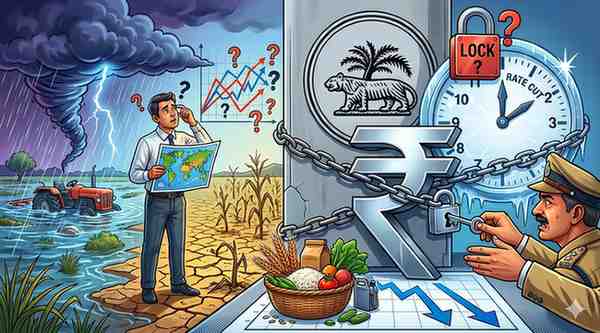
Erratic Monsoon Forecasts Could Force RBI to Delay Rate Cuts Despite Cooling Core Inflation
- admin
- April 16, 2026
- Uncategorized
- 0 Comments
India’s monetary policy trajectory faces disruption as early monsoon irregularities threaten to spike food inflation, potentially delaying the Reserve Bank of India’s anticipated rate-cutting cycle. The central bank may be forced to maintain its cautious stance through Q2 2026 despite headline inflation remaining within target bands, as agricultural output volatility historically transmits rapidly to consumer prices.
New Delhi, April 2026 — The India Meteorological Department’s preliminary monsoon assessment signals uneven rainfall distribution across key agricultural belts, raising concerns that food price pressures could resurface just as the RBI had gained confidence in its disinflation narrative. Consumer price inflation stood at 4.2% in March 2026, comfortably within the RBI’s 2-6% tolerance band, but food inflation remained elevated at 6.8%, underscoring the economy’s persistent vulnerability to weather-driven supply shocks.
What Is Driving the Inflation Concern?
India’s food basket constitutes approximately 46% of the Consumer Price Index weighting, making headline inflation exceptionally sensitive to agricultural output fluctuations. The southwest monsoon, which delivers nearly 70% of India’s annual rainfall, directly determines kharif crop yields for rice, pulses, and oilseeds. Meteorological models now indicate a 35% probability of below-normal rainfall in Maharashtra, Karnataka, and Telangana — states responsible for 28% of national foodgrain production. The 2023 experience, when tomato prices spiked 200% within weeks due to localised crop damage, remains fresh in policymakers’ institutional memory.
What Does This Mean for RBI’s Rate Decision Path?
The RBI’s Monetary Policy Committee had signalled a dovish pivot in its February 2026 review, with Governor Sanjay Malhotra acknowledging space for accommodation given moderating core inflation. Market consensus had priced in 50 basis points of cumulative cuts by September 2026. A monsoon-induced food price shock would complicate this trajectory, forcing the MPC to weigh growth support against inflation credibility. The central bank’s forward guidance explicitly conditions easing on “durable disinflation,” a threshold that weather volatility could undermine within weeks of actual monsoon onset.
How Does This Compare to Previous Monsoon Disruptions?
India experienced analogous policy constraints during the 2019 monsoon, when delayed rainfall pushed food inflation from 2.9% in June to 7.9% by October, forcing the RBI to pause its easing cycle despite weak industrial growth. The 2014 El Niño episode similarly compelled two consecutive years of restrictive policy despite sub-6% GDP growth. Unlike advanced economies where central banks can largely ignore food price transience, India’s consumption patterns mandate that the RBI treat food inflation as a first-order policy variable.
- Food items constitute 46% of India’s CPI basket, versus 14% in the United States and 22% in the European Union
- March 2026 headline CPI: 4.2%; food inflation: 6.8%; core inflation: 3.4%
- Southwest monsoon contributes 70% of annual precipitation between June and September
- 2023 tomato crisis: prices rose from ₹40/kg to ₹120/kg within six weeks due to crop damage
- RBI repo rate currently at 6.0%, with markets pricing 50bps cuts by September 2026
What Should Investors and Businesses Watch?
Bond market participants should monitor IMD’s June rainfall updates and reservoir storage levels across major dam systems as leading indicators of agricultural stress. Corporate treasurers in FMCG and food processing sectors face margin compression risk if input costs accelerate while demand remains subdued. Equity investors should note that rate-sensitive sectors — real estate, automobiles, NBFCs — had rallied 12% year-to-date on easing expectations, positioning them for correction if the RBI delays action.
Analyst’s View
The RBI confronts a familiar dilemma where external supply shocks constrain monetary flexibility regardless of underlying demand conditions. Should June-July rainfall disappoint materially, expect the MPC to adopt explicit data-dependent language while deferring cuts to Q4 2026. The more consequential development to monitor is whether the government deploys supply-side interventions — buffer stock releases, import duty adjustments — that could provide the RBI political cover to ease despite elevated food readings. Absent such coordination, the growth-inflation trade-off tilts hawkish through the monsoon season.