Carnegie’s Security Dialogue with Heribert Dieter Signals Renewed Focus on Geoeconomic Fragmentation Risks
- admin
- April 17, 2026
- Uncategorized
- 0 Comments
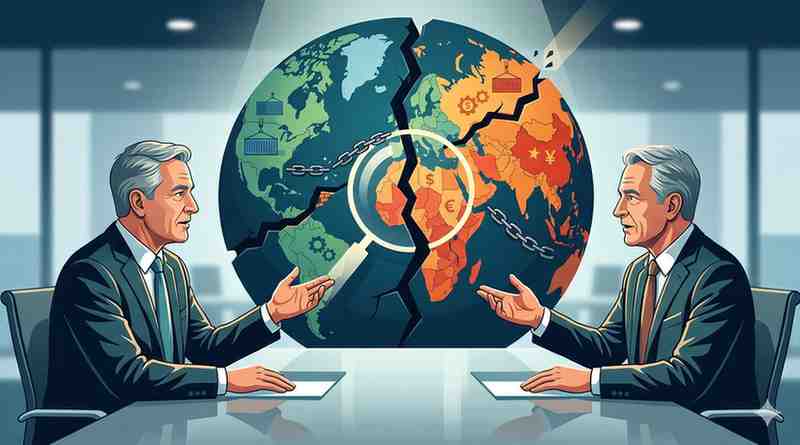
The Carnegie Endowment for International Peace convened a security studies seminar featuring German economist Heribert Dieter, signalling intensified Western think-tank focus on geoeconomic fragmentation and trade weaponisation. This dialogue carries direct implications for India’s strategic positioning as middle powers navigate an increasingly bifurcated global economic architecture.
New Delhi, April 2025 — The Carnegie Endowment’s decision to host Heribert Dieter, a senior fellow at the German Institute for International and Security Affairs (SWP) and specialist in international political economy, reflects growing anxiety within transatlantic policy circles about the durability of multilateral economic institutions. Dieter has emerged as a prominent voice arguing that the post-1945 liberal economic order faces structural — not cyclical — challenges, a thesis with profound implications for export-dependent emerging economies including India.
Who Is Heribert Dieter and Why Does His Analysis Matter?
Heribert Dieter serves as a senior associate at SWP Berlin, Germany’s most influential foreign policy think tank, where he specialises in global financial governance, trade policy, and Asia-Pacific economic integration. Dieter has consistently warned that weaponisation of economic interdependence — through sanctions, export controls, and financial exclusion — risks fragmenting the global economy into competing blocs. His scholarship directly addresses whether institutions like the WTO and IMF can survive great-power competition, a question central to India’s own multilateral diplomacy.
What Is Driving This Security-Economics Convergence?
Carnegie’s framing of economic policy within a security studies seminar reflects a fundamental shift in how Western institutions conceptualise trade and finance. The boundary between economic policy and national security has collapsed since 2022, with semiconductor export controls, SWIFT exclusions, and critical mineral restrictions becoming standard geopolitical tools. Dieter’s research examines whether this securitisation of economics creates irreversible damage to globalisation or whether managed decoupling remains feasible.
What Does This Mean for India’s Strategic Calculus?
India occupies a distinctive position in this fragmenting landscape as a democracy maintaining strategic autonomy while deepening ties with both Western and non-Western partners. Dieter’s analysis of geoeconomic fragmentation directly informs debates within South Block about supply chain diversification, rupee internationalisation, and participation in alternative payment architectures. New Delhi’s policymakers must assess whether hedging strategies remain viable as bloc formation accelerates.
- Heribert Dieter has authored over 150 publications on international economic governance since joining SWP in 2001
- Carnegie Endowment ranks among the top three most influential foreign policy think tanks globally according to the University of Pennsylvania’s Global Go To Think Tank Index
- Germany-India bilateral trade reached €28.4 billion in 2024, making Germany India’s largest European trading partner
- SWP Berlin advises the German Bundestag and Federal Government directly on foreign and security policy
- The term “geoeconomics” has appeared in 340% more policy papers since 2020 compared to the previous five-year period
How Does This Compare to Previous Geoeconomic Transitions?
The last comparable period of economic bloc formation occurred during the 1930s, when competitive devaluations and trade barriers contributed to geopolitical catastrophe. Dieter’s work examines whether contemporary institutions possess sufficient resilience to prevent similar outcomes. The 1970s petrodollar recycling crisis and 2008 financial contagion offer partial precedents, but neither involved deliberate weaponisation of interdependence at current scales.
Analyst’s View
Carnegie’s engagement with Dieter suggests transatlantic policy elites are preparing frameworks for managed fragmentation rather than globalisation repair. India should monitor whether such dialogues produce concrete policy recommendations on friend-shoring arrangements, critical technology access, and financial architecture alternatives. The Dieter seminar represents intellectual groundwork for decisions that will shape trade corridors and investment flows for decades — New Delhi’s absence from such conversations carries strategic cost.