Putin Offers Trump a Nuclear “Middle Path” for Iran
- Editor
- May 1, 2026
- Uncategorized
- 0 Comments
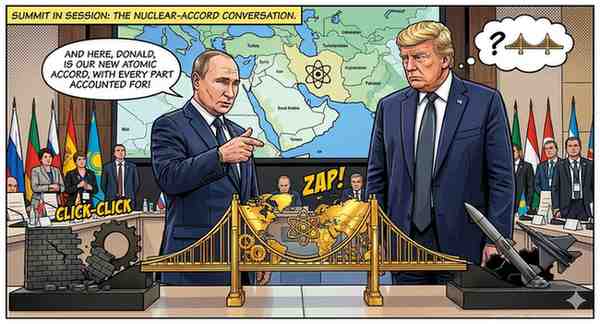
Moscow, May 2026 — A high-stakes 90-minute phone call between Russian President Vladimir Putin and U.S. President Donald Trump has revealed a potential breakthrough—or a sophisticated geopolitical trap—regarding Iran’s nuclear ambitions. As the threat of regional war looms, Putin has officially offered to take custody of Iran’s 11-tonne stockpile of enriched uranium, aiming to neutralize the “nuclear trigger” that has pushed the Middle East to the brink.
The 11-Tonne Threat
The core of the current crisis lies in Iran’s rapidly advancing enrichment capabilities. Intelligence reports suggest Iran currently holds 11 tonnes of enriched uranium, with a critical 440 kilograms already enriched to 60% purity.
While weapons-grade uranium requires 90% enrichment, the jump from 60% to 90% is technically minor. This has reduced Iran’s “breakout time”—the window needed to produce a nuclear device—to a matter of weeks, a reality the Trump administration has cited as a primary justification for recent military posturing.
Putin’s “Custody” Proposal
Leveraging a recent high-level visit from Iranian Foreign Minister Abbas Araghchi to Moscow, Putin proposed that Russia act as a global “nuclear locker.” Under this plan:
- Transfer: Iran would ship its entire stockpile of enriched uranium to Russian soil.
- Monitoring: Russia would guarantee the material is not weaponized, providing a layer of security that Tehran refuses to grant to Western powers.
- Diplomatic Shield: This allows Iran to maintain its “sovereign right” to nuclear technology without actually possessing the material required for a bomb.
Trump’s Cold Shoulder: “Fix Ukraine First”
Despite the scale of the offer, President Trump did not immediately embrace the deal. Sources indicate that Trump used the call to practice “strategic distancing,” acknowledging the proposal but shifting the burden back to the Kremlin.
Trump reportedly told Putin to focus on ending the war in Ukraine before attempting to broker peace in the Middle East. This response highlights a deep-seated mistrust in Washington; U.S. officials fear that allowing Russia to hold the uranium would merely hand Moscow a massive geopolitical lever, making the U.S. dependent on Putin to keep Iran in check.
The $125 Oil Reality
While the leaders haggle over diplomacy, the global economy is feeling the friction. Oil prices have surged to $125 per barrel, the highest level in four years. The naval standoff in the Strait of Hormuz and the threat of a “multi-nuclear” Middle East—where Saudi Arabia and Turkey might feel forced to build their own bombs—has created a “risk premium” that is draining global markets.
The Trust Deficit
The proposal faces a massive enforcement hurdle. Critics in the U.S. argue that Russia and Iran are too closely aligned for Moscow to be a neutral arbiter. There are fears that “compliance” would be a facade, and that Russia could covertly return the material or technology to Tehran if its own interests were threatened.
Bottom Line
Putin is positioning himself as the ultimate global broker, offering a solution that could technically stop a war. However, Trump’s refusal to bite suggests the U.S. isn’t ready to let Moscow claim a diplomatic victory in West Asia. For now, the 11 tonnes of uranium remain in Iranian centrifuges, and the world remains one misstep away from a nuclear-tinged conflict.