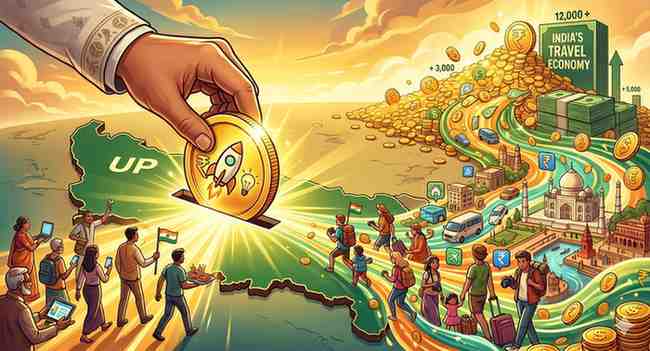
Uttar Pradesh’s Tourism Startup Scheme Signals State-Level Push to Capture India’s $50 Billion Travel Economy
- admin
- April 26, 2026
- Uncategorized
- 0 Comments
Uttar Pradesh has launched a dedicated startup scheme targeting tourism entrepreneurs, marking one of India’s most populous states’ direct entry into competitive tourism investment incentivisation. The ‘New Tourism Startup Units Scheme’ aims to channel private capital and technological innovation into a sector where UP possesses significant untapped heritage assets but has historically underperformed relative to southern and western states.
New Delhi, April 2025 — The Uttar Pradesh government’s newly announced tourism startup initiative represents a calculated policy intervention in a state that houses India’s most visited religious circuits yet captures a disproportionately small share of high-value leisure tourism spending. Chief Minister Yogi Adityanath’s administration is betting that startup-driven innovation can bridge the gap between footfall volume and revenue realisation across destinations including Varanasi, Ayodhya, and the Braj region.
What Is the Scheme’s Strategic Intent?
Uttar Pradesh’s tourism startup scheme targets early-stage ventures operating in hospitality technology, heritage experiences, pilgrimage logistics, and destination management. The policy framework provides capital subsidies, regulatory fast-tracking, and access to state tourism infrastructure for qualifying startups. UP’s approach mirrors successful models deployed by Karnataka and Kerala, which have integrated startup ecosystems into their tourism development strategies since 2018. The state is explicitly positioning itself to compete for entrepreneurial talent that has historically gravitated toward Bengaluru and Mumbai.
Why Does This Matter for India’s Tourism Sector?
India’s domestic tourism market crossed ₹2.3 lakh crore in 2024, with religious tourism contributing nearly 60% of total trips. Uttar Pradesh receives over 300 million domestic tourists annually but generates lower per-visitor revenue than Rajasthan or Goa. Startup-led innovation in booking platforms, experience curation, and accommodation aggregation could address this value gap. The scheme also aligns with the Centre’s push under the Swadesh Darshan 2.0 programme to develop tourism circuits through public-private collaboration.
What Are the Key Policy Features?
- Capital subsidy of up to 25% on fixed investments for tourism startups registered in UP
- Single-window clearance mechanism promising approvals within 30 days
- Priority access to heritage sites and government-owned properties for pilot projects
- Integration with UP’s existing MSME incentive framework for working capital support
- Dedicated incubation support through state tourism department partnerships
How Does This Compare to Other States?
Karnataka’s tourism startup programme, launched in 2019, has incubated 47 ventures with a combined valuation exceeding ₹800 crore. Rajasthan’s heritage tourism startup initiative attracted ₹120 crore in private investment between 2021-2024. Uttar Pradesh enters this competitive landscape with inherent advantages in pilgrim traffic density and UNESCO-listed heritage sites. The state’s challenge lies in execution consistency, given its historically complex regulatory environment for private enterprise.
Analyst’s View
Uttar Pradesh’s tourism startup scheme represents sound policy design but will be judged entirely on implementation velocity and bureaucratic follow-through. Investors should monitor three indicators over the next 18 months: the number of startups actually onboarded, disbursement rates of promised subsidies, and whether the single-window mechanism delivers on its 30-day commitment. The scheme’s success could catalyse similar initiatives across Bihar, Madhya Pradesh, and Odisha, potentially reshaping India’s tourism investment geography away from its current coastal and southern concentration. For startup founders, UP offers scale that no other Indian state can match — the question is whether state capacity can keep pace with entrepreneurial ambition.