France 2026: Reform vs street pressure—how stability gets priced
- admin
- January 28, 2026
- People, World View
- 0 Comments
Key highlights
- France’s “stability premium” shows up first in bond yields and borrowing costs, not in TV debates. aft.gouv.fr
- Fiscal repair is the core pressure point: the EU-side paperwork for 2026 keeps deficit/debt numbers in focus. Economy and Finance
- The stress isn’t reforms vs protests; it’s reforms vs delay—because delay changes the funding bill. Economy and Finance+1
- Official forecasts already build in a cautious path for 2026 growth/inflation—conditional on clarity and credibility. Banque de France+1
France in 2026 is a market lesson disguised as politics: stability is a number. If investors trust that a country will pass budgets, deliver reforms, and keep deficit math believable, the country borrows cheaper. If trust weakens, borrowing costs rise—and suddenly “politics” becomes a line item.
What does “stability gets priced” actually mean?
France issues debt continuously; the state’s funding cost is anchored to sovereign yields. Agence France Trésor publishes benchmark references like the 10-year constant maturity yield (TEC 10) that markets use as a headline signal. aft.gouv.fr When the perception of policy continuity weakens, yields can rise, pushing up interest costs over time—especially as older debt rolls over.
Why the 2026 budget matters more than the slogans
The European Commission’s published assessment around France’s draft budgetary plan includes explicit deficit and debt projections for 2026 (with the Commission also publishing its own forecast). Economy and Finance This is why “budget season” becomes market season: it’s a public, audited scoreboard.
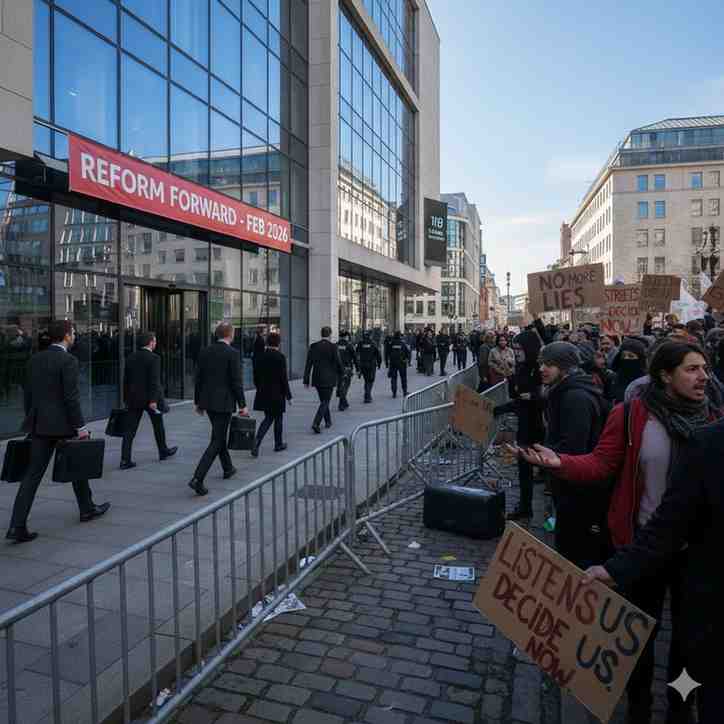
Reform vs street pressure: the real collision point
Street pressure doesn’t automatically “win” or “lose.” It re-times policy. When reforms are delayed or diluted, governments often need either (a) new revenue, (b) spending restraint elsewhere, or (c) more borrowing. That’s the mechanism through which protests can convert into funding stress—without any dramatic crisis language. IMF surveillance reports regularly emphasise the importance of credible medium-term fiscal paths and implementation capacity. IMF
What the official forecasts imply for 2026
Banque de France’s published macroeconomic projections provide a baseline view for growth and inflation into 2026–2028. Banque de France+1 INSEE’s inflation releases show the near-term inflation environment feeding into wage bargaining and household sentiment—another quiet driver of political temperature. insee.fr
Small questions people actually search
- Will France’s strikes crash the economy in 2026?
Not automatically. The risk is usually confidence + delay, which then shows up in financing conditions and investment timing. IMF+1 - How do I “see” instability in data?
Watch sovereign yield benchmarks (AFT), and the official fiscal track published through EU budgetary-plan documents. aft.gouv.fr+1 - What’s the practical takeaway for businesses?
Plan for volatility in demand signals, hiring sentiment, and funding conditions when fiscal negotiations get messy—because the market reprices faster than legislation moves.