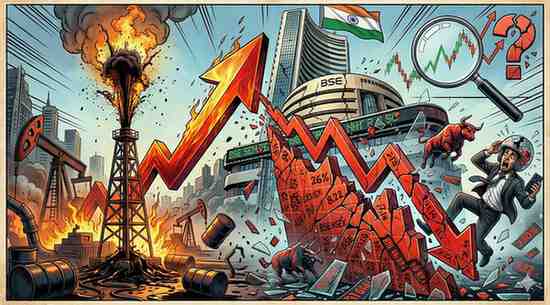
Why Oil Price Surge Triggered an 800-Point Sensex Crash and What It Signals for Indian Equities
- admin
- April 9, 2026
- Uncategorized
- 0 Comments
Indian benchmark indices suffered their steepest single-day decline in three months as Brent crude surged past $90 per barrel, reigniting inflation fears and triggering broad-based selling across rate-sensitive sectors. The Sensex plunged over 800 points while the Nifty 50 breached the critical 22,750 support level, signalling renewed vulnerability in an equity market that had appeared resilient through Q1 2025.
New Delhi, April 2025 — The carnage on Dalal Street erased approximately ₹4.2 lakh crore in investor wealth within a single trading session, with foreign institutional investors offloading equities worth ₹3,100 crore in a risk-off move that echoed the oil-driven selloffs of 2022. Banking, aviation, and paint stocks bore the brunt of the correction, reflecting investor anxiety over input cost escalation and compressed margins.
What Is Driving the Market Selloff?
Brent crude prices spiked 4.8% following supply disruption fears stemming from renewed tensions in the Middle East and OPEC+ signalling continued production restraint. India imports approximately 85% of its crude oil requirements, making the economy acutely sensitive to global energy price movements. The rupee weakened past 83.6 against the dollar, compounding import costs and amplifying FII outflows. Market participants are now pricing in a potential delay to the Reserve Bank of India’s anticipated rate-cutting cycle, with bond yields hardening in response.
What Does This Mean for India’s Inflation Trajectory?
Every $10 per barrel increase in crude prices adds approximately 40-50 basis points to India’s headline inflation over a six-month lag. The RBI’s monetary policy committee, which held rates steady at 6.5% in its February review, now faces a complicated calculus as growth momentum confronts renewed price pressures. Fuel price revisions by oil marketing companies remain politically sensitive ahead of state elections, potentially forcing the government to absorb costs through fiscal measures. Current account deficit projections for FY26 may require upward revision if oil sustains above $90 for an extended period.
How Does This Compare to Previous Oil Shocks?
The last comparable oil-driven market correction occurred in October 2022 when Brent touched $95 and the Nifty fell 5.2% over two weeks. India’s foreign exchange reserves stand stronger today at $642 billion compared to $528 billion during that episode, providing greater buffer capacity. However, FII positioning has turned more cautious in 2025, with year-to-date net outflows of ₹28,000 crore contrasting with net inflows during the 2022 correction. The structural vulnerability to energy imports remains India’s most significant macroeconomic exposure.
- Sensex declined 812 points (2.6%) to close at 30,487; Nifty 50 fell 2.4% to 22,738
- Brent crude surged to $91.2 per barrel, highest level since October 2024
- Bank Nifty dropped 2.9% with HDFC Bank and ICICI Bank leading losses
- India VIX spiked 18% to 14.8, indicating elevated near-term volatility expectations
- Rupee depreciated 0.4% to 83.62, its weakest close in six weeks
What Should Investors Watch Going Forward?
Crude oil inventory data from the US Energy Information Administration, scheduled for release Thursday, will provide immediate directional cues for energy prices. The RBI’s April policy statement gains heightened significance as markets seek clarity on the central bank’s tolerance for imported inflation. Quarterly earnings from oil marketing companies and aviation firms in late April will reveal margin pressures with greater precision. Investors should monitor the 22,500 Nifty level as the next technical support — a breach could trigger algorithmic selling and extend the correction.
Analyst’s View
The market’s violent reaction underscores that India’s equity valuations, trading at 19x forward earnings, leave minimal margin for macroeconomic surprises. Oil above $90 for more than four weeks would likely force the RBI to pause any rate easing until late 2025, compressing multiples further in rate-sensitive sectors. Strategic investors should consider reducing exposure to airlines, paints, and logistics while building positions in upstream oil producers and IT exporters who benefit from rupee weakness. The next 30 days will determine whether this correction represents a buying opportunity or the beginning of a deeper de-rating cycle.