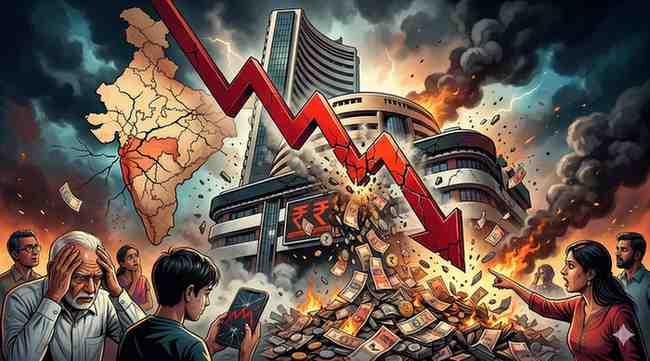
Why Did Indian Equities Shed ₹12 Lakh Crore in a Single Session? Unpacking the Six-Factor Selloff
- admin
- April 10, 2026
- Uncategorized
- 0 Comments
Indian benchmark indices suffered their steepest single-day decline in three months on Thursday, with the Sensex plunging 931 points and the Nifty 50 breaching the critical 23,900 support level amid a confluence of global and domestic headwinds. The selloff, driven by escalating US-China trade tensions, weakening rupee, and sustained foreign institutional outflows, erased approximately ₹12 lakh crore in investor wealth within hours.
New Delhi, April 2025 — The Bombay Stock Exchange’s benchmark Sensex closed 931 points lower at 23,847, marking the index’s worst single-session performance since January 2025, when markets had tumbled following hawkish US Federal Reserve commentary. Foreign institutional investors accelerated their exit from Indian equities, recording net outflows exceeding ₹4,200 crore in Thursday’s session alone.
What Is Driving This Market Correction?
Six distinct factors converged to trigger Thursday’s sharp decline. Escalating US-China tariff rhetoric dominated global sentiment, with Washington announcing potential new levies on Chinese semiconductors. The Indian rupee breached 86.50 against the US dollar, its weakest level in six weeks, amplifying concerns about imported inflation and foreign capital flight. Crude oil prices spiked above $88 per barrel on Middle East supply disruption fears, directly threatening India’s current account balance. Domestic institutional investors failed to provide adequate counterweight, with mutual fund buying insufficient to absorb FII selling pressure.
What Does This Mean for Indian Investors?
Retail investors holding leveraged positions in mid-cap and small-cap segments face immediate margin pressures as the broader market correction deepens. The Nifty Midcap 100 index fell 3.2 percent, significantly underperforming the frontline indices. Portfolio rebalancing toward defensive sectors—pharmaceuticals, FMCG, and utilities—has already begun, evidenced by relative outperformance in these segments. Systematic investment plan investors, however, benefit from rupee-cost averaging at lower valuations.
How Does This Compare With Previous Market Shocks?
The magnitude of Thursday’s decline mirrors the October 2024 selloff triggered by geopolitical tensions in West Asia, when the Sensex had shed 1,100 points intraday before partial recovery. Current valuations, with the Nifty trading at 19.8 times forward earnings, remain elevated compared to the five-year average of 18.2 times. Market breadth deteriorated sharply, with 2,847 stocks declining against just 612 advancing on the BSE—a ratio worse than during the March 2023 banking crisis.
- Sensex declined 931 points (3.8%) to close at 23,847; Nifty 50 settled at 23,876
- Foreign institutional investors sold equities worth ₹4,200 crore in a single session
- Indian rupee weakened to 86.52 against the US dollar, down 0.7% intraday
- Brent crude surged to $88.40 per barrel, up 2.3% on supply concerns
- Market capitalisation erosion estimated at ₹12 lakh crore across BSE-listed companies
What Should Investors Watch Next?
The Reserve Bank of India’s upcoming monetary policy commentary on April 15 will signal whether policymakers view the rupee weakness as transient or requiring intervention. US employment data releasing Friday could determine whether the Federal Reserve maintains its hawkish stance, directly influencing emerging market capital flows. Technical analysts identify 23,500 as the next critical Nifty support level, with a breach potentially triggering algorithmic selling cascades.
Analyst’s View
Thursday’s selloff represents a sentiment-driven correction rather than fundamental deterioration in India’s growth trajectory. Corporate earnings for Q4 FY25, due from mid-April, will determine whether current valuations remain defensible. Investors should monitor the dollar index and US 10-year Treasury yields as leading indicators of FII behaviour. The correction creates selective accumulation opportunities in export-oriented IT services and import-substitution manufacturing sectors, though volatility will likely persist until global trade policy uncertainty resolves. Markets may test 23,200-23,400 range before establishing a sustainable floor.