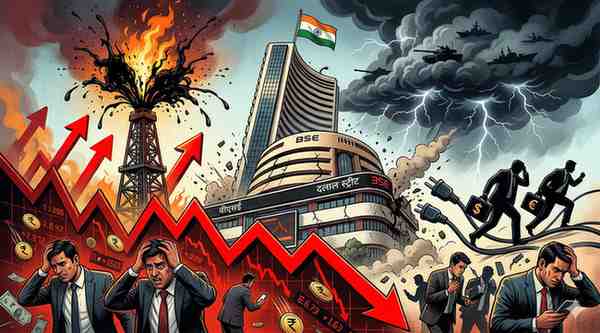
Triple Shock Hits Dalal Street: Oil Surge, FII Exit and Geopolitical Risk Converge to Drag Indian Equities
- admin
- April 9, 2026
- Uncategorized
- 0 Comments
Indian benchmark indices Sensex and Nifty fell sharply as a confluence of rising crude oil prices, heightened geopolitical tensions, and sustained foreign institutional investor (FII) outflows created a triple headwind for domestic equities. The sell-off reflects structural vulnerabilities in India’s market positioning rather than isolated profit-booking, warranting close monitoring of global risk factors in the sessions ahead.
New Delhi, April 2025 — Indian equity markets registered significant losses as Brent crude breached key resistance levels amid escalating tensions in the Middle East, triggering a risk-off sentiment that accelerated foreign capital flight from emerging market assets. The Sensex shed over 500 points intraday while the Nifty 50 breached crucial technical support levels, marking the steepest single-session decline in three weeks.
What Is Driving the Market Sell-Off?
Three distinct but interconnected forces are pressuring Indian equities simultaneously. Crude oil prices surged past $88 per barrel following reports of supply disruptions and regional conflict escalation, directly threatening India’s import bill and current account deficit. Foreign institutional investors withdrew approximately ₹4,200 crore from Indian equities in the first week of April alone, continuing a pattern of outflows that began when US Treasury yields climbed above 4.5 percent. Geopolitical uncertainty has elevated the VIX India volatility index to levels last seen during the Russia-Ukraine conflict escalation in early 2022.
What Does This Mean for India’s Economy?
India imports over 85 percent of its crude oil requirements, making the economy acutely sensitive to energy price shocks. Every $10 per barrel increase in oil prices adds approximately 0.4 percentage points to headline inflation and widens the current account deficit by roughly $15 billion annually. The Reserve Bank of India’s inflation management task becomes considerably more complex when supply-side pressures coincide with global monetary tightening. Corporate earnings for oil-dependent sectors including aviation, paints, and logistics face margin compression in Q1 FY26.
How Does This Compare to Previous Market Corrections?
The current sell-off echoes patterns observed during the September 2018 correction when oil prices, rupee depreciation, and FII outflows converged to pull the Nifty down 11 percent from its peak. However, India’s macroeconomic buffers are stronger today, with foreign exchange reserves exceeding $640 billion and fiscal deficit trending lower than projections. Domestic institutional investors, particularly mutual funds receiving sustained SIP inflows of ₹19,000 crore monthly, have provided countervailing support absent during previous episodes.
- Brent crude prices crossed $88/barrel, highest since October 2024
- FII net outflows reached ₹4,200 crore in April’s first week
- India VIX spiked 18 percent to 14.8, signalling elevated fear
- Rupee weakened to 83.95 against the dollar, pressuring import costs
- Oil marketing companies’ stocks fell 3-5 percent on margin concerns
What Should Investors Watch Going Forward?
Near-term market direction hinges on three variables: the trajectory of West Asian tensions, upcoming US inflation data influencing Federal Reserve rate expectations, and the pace of FII selling relative to DII absorption capacity. The April 12 expiry of monthly derivatives contracts may amplify volatility as traders unwind positions. Earnings season beginning mid-April will test whether corporate India’s pricing power can withstand input cost pressures.
Analyst’s View
The current correction represents a repricing of geopolitical risk premiums rather than fundamental deterioration in India’s growth narrative. Investors should monitor crude oil’s $90 per barrel threshold as a critical trigger for further downside, while watching whether FII outflows stabilise once US rate expectations settle. Sectors with domestic revenue streams and low commodity exposure — financials, healthcare, and consumer staples — offer relative shelter. The medium-term investment case for Indian equities remains intact, but tactical caution is warranted until global risk appetite stabilises.