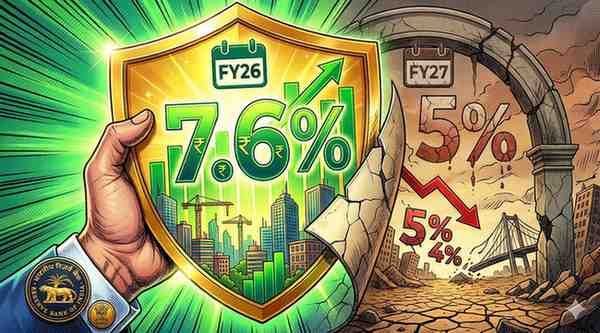
RBI’s Upgraded 7.6% Growth Forecast for FY26 Masks Structural Slowdown Concerns for FY27
- admin
- April 11, 2026
- Uncategorized
- 0 Comments
The Reserve Bank of India has revised its FY26 GDP growth projection upward to 7.6%, reflecting stronger-than-expected domestic consumption and investment momentum. However, the central bank’s simultaneous forecast of a deceleration to 6.9% in FY27 signals mounting concerns over global headwinds and the sustainability of India’s current growth trajectory.
New Delhi, April 2025 — The RBI’s decision to lift its FY26 growth estimate by approximately 20-30 basis points from earlier projections represents the most significant upward revision since the post-pandemic recovery period of FY22, when actual growth consistently surprised forecasters on the upside. This recalibration arrives at a critical juncture, with India positioning itself as the fastest-growing major economy while navigating an increasingly volatile global trade environment.
What Is Driving the Upgraded FY26 Forecast?
Rural demand resurgence following two consecutive years of healthy monsoons has strengthened the consumption base that contributes nearly 60% of India’s GDP. Capital expenditure by both government and private sector has maintained robust momentum, with infrastructure spending remaining a policy priority. The services sector, particularly financial services and IT, continues to demonstrate resilience despite global tech sector corrections. Manufacturing output has benefited from Production-Linked Incentive schemes, with electronics and pharmaceuticals showing notable export growth.
Why Does the RBI Expect Growth to Moderate in FY27?
The projected 70 basis point deceleration to 6.9% reflects the RBI’s assessment that several tailwinds supporting current growth are temporary rather than structural. Global demand conditions remain uncertain, with major economies including the United States and European Union showing signs of sustained slower growth. The base effect from a strong FY26 will mathematically compress growth rates in the following year. Geopolitical tensions, particularly in energy markets and trade routes, pose persistent risks to India’s import-dependent manufacturing sector.
How Does This Compare to Previous Growth Cycles?
India last achieved sustained growth above 7% during the pre-demonetisation period of FY16-17, making the current projection historically significant. The FY27 forecast of 6.9% would still place India comfortably above China’s projected 4.5-5% range and ahead of most emerging market peers. The RBI’s forecasting accuracy has improved markedly since 2022, with actual outcomes falling within 30 basis points of projections in three of the last four quarters.
- FY26 GDP growth revised to 7.6%, up from earlier estimates of approximately 7.2-7.4%
- FY27 growth projected at 6.9%, representing a 70 basis point moderation
- India’s growth premium over China expected to widen to approximately 200-250 basis points
- Services sector contributing roughly 55% of growth momentum in current fiscal
- Capital expenditure growth maintaining double-digit trajectory for third consecutive year
What Should Investors and Policymakers Watch?
Monsoon performance in 2025 will be critical, as agricultural output directly influences rural consumption patterns that have underpinned recent growth. The trajectory of global interest rates, particularly Federal Reserve policy decisions, will affect foreign portfolio flows and rupee stability. Corporate earnings growth in Q1 and Q2 of FY26 will provide early validation of the RBI’s optimistic assessment. Infrastructure project execution rates and private sector capacity utilisation data will signal whether investment momentum can be sustained.
Analyst’s View
The RBI’s bifurcated outlook — bullish near-term, cautious medium-term — accurately reflects India’s current economic positioning. Structural reforms in labour markets, land acquisition, and judicial efficiency remain incomplete, placing a ceiling on potential growth rates above 7.5% over extended periods. The central bank’s implicit message is clear: India’s growth engine is firing on most cylinders today, but sustaining this performance requires policy continuity and global cooperation that cannot be assumed. Market participants should treat the FY27 moderation not as pessimism but as realistic calibration, and monitor quarterly GDP prints against the RBI’s trajectory to assess whether India is outperforming or underdelivering on its considerable economic promise.