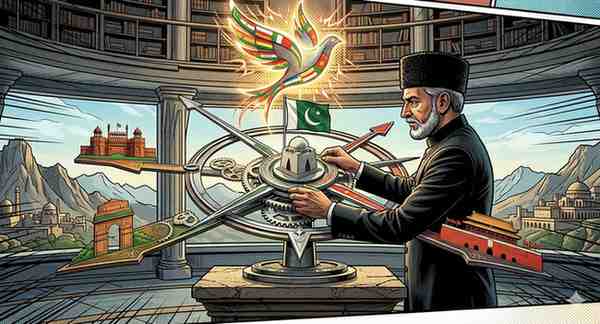
Pakistan’s Diplomatic Pivot: Can Islamabad Reinvent Itself as a Regional Mediator?
- admin
- April 10, 2026
- Uncategorized
- 0 Comments
Pakistan is positioning itself as a regional peacemaker, seeking to shed its image as a conflict-prone state and emerge as a credible diplomatic intermediary in South Asian and Middle Eastern disputes. This strategic recalibration reflects Islamabad’s urgent need to attract foreign investment, stabilise its economy, and reduce dependence on military-centric foreign policy frameworks.
New Delhi, April 2025 — Pakistan’s foreign policy establishment is actively courting a new international identity, one that emphasises mediation and conflict resolution over its traditional posture of strategic confrontation. This shift, while potentially transformative for regional dynamics, faces significant credibility challenges given Pakistan’s unresolved tensions with India and Afghanistan, and its historical role in nurturing non-state actors.
What Is Driving Pakistan’s Peacemaker Ambitions?
Pakistan’s economy remains under severe strain, with IMF bailout conditions limiting fiscal flexibility and foreign exchange reserves hovering at precarious levels. Islamabad recognises that sustained economic recovery requires regional stability and improved bilateral relationships that can unlock trade corridors and foreign direct investment. The military establishment, traditionally the dominant force in foreign policy, appears willing to explore diplomatic avenues that could yield economic dividends without compromising core strategic interests. Pakistan’s facilitation role in US-Taliban negotiations between 2018 and 2020 provides a template Islamabad hopes to replicate in other contexts.
What Does This Mean for India?
New Delhi will view Pakistan’s peacemaker narrative with considerable scepticism, given the absence of meaningful progress on cross-border terrorism and the unresolved Kashmir dispute. Indian policymakers have consistently maintained that substantive dialogue requires Pakistan to dismantle terrorist infrastructure operating from its soil. Any Pakistani success in positioning itself as a regional mediator could complicate India’s diplomatic messaging, particularly in forums where Islamabad might claim equivalence as a responsible stakeholder. India’s strategic community will monitor whether this diplomatic pivot represents genuine institutional change or tactical repositioning ahead of potential talks with the incoming US administration.
How Does This Compare to Historical Precedents?
Pakistan has attempted similar diplomatic reinventions before, most notably during the Musharraf era when Islamabad projected itself as a moderate Islamic state and key counterterrorism partner. That positioning collapsed following revelations about A.Q. Khan’s nuclear proliferation network and the discovery of Osama bin Laden in Abbottabad in 2011. The current attempt differs in its economic desperation and the changed regional architecture, with China’s Belt and Road Initiative creating new incentives for Pakistani stability.
- Pakistan’s foreign exchange reserves stood at approximately USD 9 billion in early 2025, covering barely two months of imports
- The IMF’s USD 7 billion Extended Fund Facility, approved in 2024, mandates structural reforms that require regional economic integration
- Pakistan facilitated US-Taliban negotiations over 18 months, resulting in the 2020 Doha Agreement
- Bilateral trade between India and Pakistan collapsed to under USD 500 million following the 2019 Pulwama crisis, down from USD 2.4 billion in 2014
- China’s investment in the China-Pakistan Economic Corridor exceeds USD 62 billion in committed projects
What Should Investors Watch?
Foreign investors monitoring South Asian opportunities should track three indicators: any resumption of back-channel diplomacy between India and Pakistan, Pakistan’s compliance with FATF grey list requirements, and the sustainability of Islamabad’s IMF programme. Regional stability improvements could unlock significant value in logistics, energy interconnection, and manufacturing supply chains currently fragmented by political tensions. However, structural risks remain elevated until Pakistan demonstrates consistent policy implementation across civilian and military institutions.
Analyst’s View
Pakistan’s peacemaker aspirations represent economic necessity dressed as diplomatic strategy. Islamabad lacks the institutional credibility and sustained policy consistency required for effective mediation in complex regional disputes. The more realistic outcome is selective engagement on specific issues where Pakistani interests align with potential interlocutors, rather than transformation into a genuine neutral arbiter. Observers should watch for concrete confidence-building measures with India and Afghanistan over the next twelve months as the true test of whether this pivot carries substantive weight or remains rhetorical positioning for international audiences.