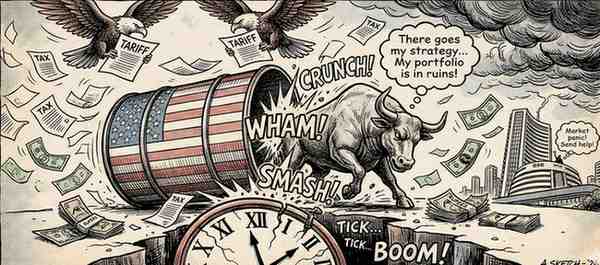
Indian Equities Deliver Double-Digit Gains in 2025 Despite Record Foreign Outflows and Global Trade Uncertainty
- admin
- April 2, 2026
- Uncategorized
- 0 Comments
Indian benchmark indices delivered robust returns in calendar year 2025, with NIFTY50 advancing 10% and SENSEX gaining 9%, defying sustained foreign institutional investor selling and escalating global trade tensions triggered by US tariff policies. Domestic institutional investors and retail participants absorbed FII outflows while PSU banking and metal sectors emerged as standout performers, underscoring India’s relative resilience amid volatile global markets.
New Delhi, April 2026 — India’s equity markets concluded 2025 with gains that outpaced most emerging market peers, a notable achievement given the headwinds that dominated the year’s trading narrative. The NIFTY50’s 10% appreciation and SENSEX’s 9% climb came against a backdrop of over ₹1.2 lakh crore in net FII outflows, the steepest annual selling by foreign portfolio investors since 2008.
What Drove Indian Markets Higher Despite Foreign Selling?
Domestic institutional investors, particularly mutual funds flush with systematic investment plan inflows, provided crucial counterbalancing demand throughout 2025. Monthly SIP contributions crossed ₹20,000 crore consistently, creating a structural bid for Indian equities that absorbed foreign selling pressure. Corporate earnings growth remained supportive, with NIFTY50 companies posting aggregate profit growth of approximately 12% year-on-year. The Reserve Bank of India’s accommodative stance in the second half of 2025, including a cumulative 50 basis point rate cut, further bolstered sentiment.
Why Did PSU Banks and Metal Stocks Outperform?
Public sector bank stocks rallied sharply as asset quality improvements and robust credit growth translated into earnings upgrades. The Nifty PSU Bank index surged over 25% during 2025, benefiting from government recapitalisation programmes and improved net interest margins. Metal stocks outperformed on the back of infrastructure spending momentum domestically and supply constraints globally, with the Nifty Metal index gaining approximately 18%. Both sectors attracted value-seeking investors rotating out of expensive private banking and technology names.
How Did Trump Tariff Policies Affect Market Sentiment?
The return of aggressive US trade policies under President Trump’s second administration created periodic volatility spikes, particularly affecting export-oriented IT and pharmaceutical sectors. India faced targeted scrutiny over trade surplus concerns, though actual tariff implementation remained selective. Markets demonstrated improved capacity to absorb geopolitical shocks compared to 2018-19, partly reflecting India’s growing domestic consumption story and reduced export dependency as a share of GDP.
- NIFTY50 annual return: +10%; SENSEX annual return: +9%
- FII net outflows in 2025: Approximately ₹1.2 lakh crore
- Monthly SIP contributions: Consistently above ₹20,000 crore
- Nifty PSU Bank index gain: Over 25%
- Nifty Metal index gain: Approximately 18%
What Does This Mean for Portfolio Strategy in 2026?
The 2025 performance demonstrated that Indian equities can deliver positive returns even during periods of sustained FII selling, a structural shift from historical patterns where foreign flows heavily dictated market direction. Valuations remain elevated relative to historical averages, with NIFTY50 trading at approximately 20 times forward earnings. Investors should anticipate continued sectoral rotation, with rate-sensitive financials and infrastructure-linked plays likely maintaining relative strength.
Analyst’s View
India’s equity market resilience in 2025 marks a maturation point, where domestic capital formation now provides genuine ballast against foreign portfolio volatility. The outperformance of PSU banks signals renewed confidence in government-linked enterprises following years of scepticism. Monitoring points for 2026 include the trajectory of US Federal Reserve policy, which influences FII allocation decisions, and domestic consumption trends that underpin corporate earnings growth. The sustainability of SIP flows through any meaningful market correction remains untested and represents a key variable for market stability.