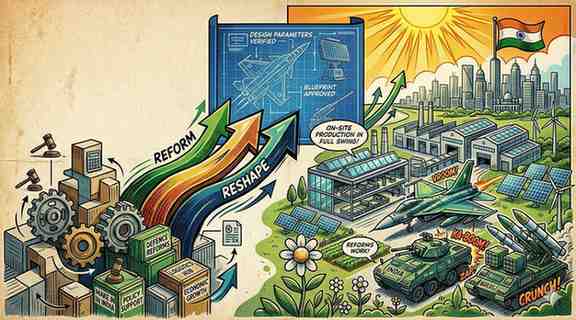
How Policy and Tax Reforms Are Reshaping India’s Defence Manufacturing Ecosystem
- admin
- April 9, 2026
- Uncategorized
- 0 Comments
India’s defence supply chain is undergoing structural transformation through coordinated policy interventions, tax rationalization, and targeted investment incentives aimed at reducing import dependence. The KPMG analysis highlights that sustainable indigenization requires addressing fragmented vendor ecosystems, working capital constraints, and technology transfer bottlenecks that continue to limit domestic manufacturing scale.
New Delhi, April 2025 — India’s defence procurement budget crossed ₹1.72 lakh crore in FY2024-25, with the government mandating that 75% of capital acquisition spending be reserved for domestic industry — a policy shift that has forced both public sector undertakings and private manufacturers to rapidly expand indigenous supply chain capabilities.
What Is Driving Defence Supply Chain Reforms?
The Ministry of Defence has published four positive indigenization lists since 2020, covering over 500 items worth approximately ₹3 lakh crore that can no longer be imported. This import embargo approach has created guaranteed demand for domestic suppliers but exposed critical gaps in component manufacturing, particularly in aerospace-grade alloys, precision electronics, and propulsion systems. KPMG’s assessment identifies taxation inconsistencies — including inverted duty structures and GST input credit blockages — as persistent friction points that erode margins for Tier-2 and Tier-3 suppliers. The 2024 budget’s extension of customs duty exemptions for defence imports by original equipment manufacturers, while beneficial for final assembly, has paradoxically disadvantaged domestic component makers competing on landed costs.
What Does This Mean for Private Sector Participation?
Private defence manufacturers now account for roughly 21% of India’s defence production value, up from less than 10% a decade ago, but their supply chain integration remains shallow. Companies like Bharat Forge, L&T Defence, and Mazagon Dock have built platform-level capabilities, yet struggle to develop resilient domestic vendor networks for mission-critical subsystems. The Defence Production and Export Promotion Policy 2020 set a ₹1.75 lakh crore production target by 2025, requiring annual growth rates that current supply chain architecture cannot sustain. Investment in testing infrastructure, quality certification facilities, and design validation centres remains inadequate outside traditional defence corridors in Bengaluru, Hyderabad, and the proposed Tamil Nadu-Uttar Pradesh nodes.
How Does India Compare to Global Defence Manufacturing Hubs?
India’s defence exports reached ₹21,083 crore in FY2023-24, a significant increase but still representing less than 0.5% of global arms trade dominated by the United States, Russia, and France. South Korea’s defence export success — growing from $2.5 billion in 2017 to over $17 billion in 2023 — demonstrates how integrated industrial policy, aggressive offset utilization, and government-backed financing can accelerate global competitiveness. India’s offset execution rate remains below 30% of contracted obligations, representing billions in unrealized technology transfer and manufacturing partnerships.
- 75% of defence capital expenditure now reserved for domestic procurement under Atmanirbhar Bharat
- Over 500 items across four indigenization lists banned from import since 2020
- Private sector defence production share increased from 10% to 21% over the past decade
- Defence exports reached ₹21,083 crore in FY2023-24, targeting ₹50,000 crore by 2028-29
- Offset execution rate remains below 30% of contractual commitments
What Should Investors Watch?
The proposed Strategic Partnership Model, designed to create Indian private sector champions in submarines, fighters, and helicopters, has produced only one active project since its 2017 announcement. Order book visibility for listed defence companies has improved, with combined outstanding orders exceeding ₹4.5 lakh crore, but execution timelines and working capital cycles remain investor concerns. The upcoming Defence Acquisition Procedure 2025 revision is expected to streamline trials, testing protocols, and payment milestones — changes that could materially improve capital efficiency for supply chain participants.
Analyst’s View
India’s defence indigenization push represents genuine structural reform rather than cyclical policy adjustment, but the gap between headline commitments and supply chain execution remains substantial. The critical variable is whether GST Council rationalization, scheduled for review in Q3 2025, addresses the inverted duty structures that penalize domestic component manufacturing. Investors should monitor the Tamil Nadu Defence Corridor’s infrastructure buildout and the operationalization of the ₹1,000 crore Defence Testing Infrastructure Scheme as leading indicators of whether India can transition from licensed assembly to genuine design-and-build capability within this decade.