Gulf Escalation Risk: How $200 Oil Would Reshape India’s Fiscal and Monetary Calculus
- admin
- April 8, 2026
- Uncategorized
- 0 Comments
Economist Nouriel Roubini has warned that escalating Iran tensions could trigger oil prices surging to $200 per barrel, a scenario that would fundamentally alter global economic conditions. For India, the world’s third-largest oil importer, such a price shock would strain fiscal balances, accelerate inflation, and force difficult trade-offs between growth support and currency defence.
New Delhi, April 2025 — Roubini’s warning arrives as geopolitical tensions in the Persian Gulf region show limited signs of de-escalation, with Iran remaining central to multiple flashpoints across West Asia. The economist, known for predicting the 2008 financial crisis, has identified a potential oil price trajectory that would represent a near-tripling from current levels and exceed the 2008 peak of $147 per barrel.
What Is Driving the $200 Oil Scenario?
Iran’s strategic position along the Strait of Hormuz gives it leverage over approximately 20 percent of global oil transit flows. Roubini’s analysis suggests that direct military confrontation or severe sanctions enforcement could disrupt this critical chokepoint. The scenario accounts for both supply destruction and risk premium expansion, where markets price in sustained uncertainty rather than temporary disruption. Historical precedent from the 1979 Iranian Revolution shows oil prices can triple within months when Persian Gulf stability deteriorates sharply.
What Does This Mean for India?
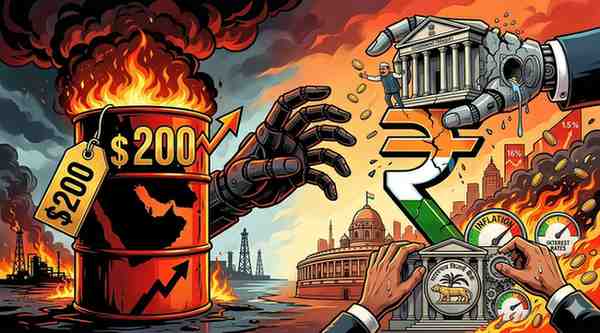
India imports roughly 85 percent of its crude oil requirements, with its annual oil import bill currently hovering around $140 billion. A $200 per barrel scenario would potentially push this figure beyond $300 billion annually, creating a current account deficit exceeding 5 percent of GDP. The Reserve Bank of India would face simultaneous pressure to defend the rupee while managing imported inflation that could push headline CPI above 8 percent. Fiscal consolidation targets would become untenable as fuel subsidy demands resurface despite deregulation reforms.
How Does This Compare to Previous Oil Shocks?
India’s economy has encountered severe oil shocks before, notably during 2008 and the 1990-91 Gulf War period. The 2008 spike to $147 per barrel contributed to India’s current account deficit widening to 2.4 percent of GDP. India’s foreign exchange reserves, currently exceeding $650 billion, provide substantially greater buffer than the $300 billion available during the 2008 shock. However, the structural dependence on imported energy has increased rather than decreased over the intervening period.
- Strait of Hormuz handles approximately 21 million barrels per day, representing 21 percent of global petroleum liquids consumption
- India’s strategic petroleum reserves currently hold only 5.33 million tonnes, covering roughly 9.5 days of consumption
- Brent crude last crossed $100 per barrel in 2022 following Russia’s invasion of Ukraine
- Indian refiners source approximately 10-12 percent of crude imports from Iran-adjacent supply chains
- Every $10 increase in oil prices adds approximately 0.4 percentage points to India’s inflation rate
What Should Investors Watch?
Currency markets would provide the earliest signals of India-specific stress, with USD-INR likely testing levels beyond 86 under a severe oil shock scenario. Oil marketing companies including Indian Oil Corporation, Bharat Petroleum, and Hindustan Petroleum would face margin compression unless retail prices adjust rapidly. Conversely, upstream producers like ONGC and Oil India could see windfall gains, though domestic pricing mechanisms would cap benefits. Aviation, logistics, and fertiliser sectors would experience immediate cost transmission.
Analyst’s View
Roubini’s $200 scenario represents a tail risk rather than a baseline forecast, but prudent policy planning requires stress-testing against such outcomes. India’s energy transition investments and strategic reserve expansion programme gain renewed urgency under this framework. The RBI’s inflation-targeting mandate would face its most severe test since the framework’s 2016 adoption, potentially forcing a choice between growth sacrifice and target suspension. Investors should monitor Strait of Hormuz shipping insurance rates and Iranian diplomatic developments as leading indicators, while building optionality through energy sector hedges and reduced exposure to import-dependent industrials.