Brussels-Delhi Reset: Why the EU-India Strategic Partnership Marks a Pivot Away from US-Centric Alignments
- admin
- April 8, 2026
- Uncategorized
- 0 Comments
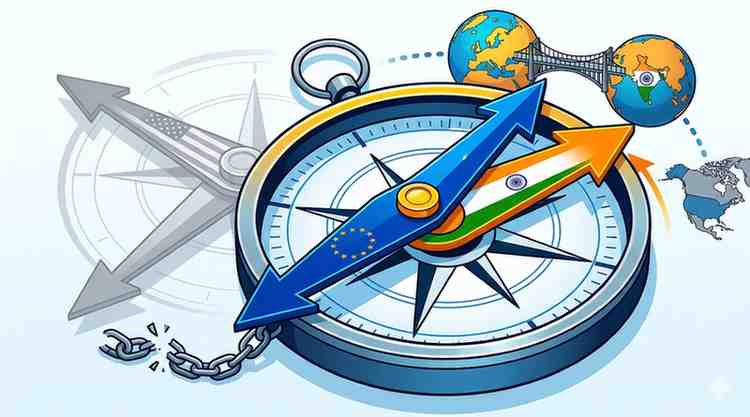
The European Union and India have formalised a renewed strategic partnership that repositions both powers as counterweights in an increasingly fractured global order. This recalibration reflects shared concerns over American trade unpredictability and Chinese assertiveness, creating a third pole in great-power competition.
New Delhi, April 2026 — The EU-India strategic partnership renewal, announced following high-level consultations in Brussels, represents the most significant upgrade in bilateral ties since the 2004 declaration of strategic partnership. The agreement encompasses enhanced cooperation across trade, critical minerals, defence technology, and climate finance — areas where both blocs have grown wary of over-dependence on either Washington or Beijing.
What Is Driving This Strategic Convergence?
The Trump administration’s return to aggressive tariff policies has accelerated European and Indian interest in diversifying economic partnerships. Brussels faces a transatlantic relationship strained by threatened auto tariffs and defence burden-sharing disputes. New Delhi, meanwhile, navigates between maintaining its Quad commitments and preserving strategic autonomy amid pressure to align more explicitly against China. The partnership allows both parties to hedge without abandoning existing alliances, a calibrated diplomatic manoeuvre characteristic of multipolarity.
What Does This Mean for India’s Trade Architecture?
India’s stalled free trade agreement negotiations with the EU, dormant since 2013, now have renewed momentum under the partnership framework. The bilateral trade corridor, valued at approximately €120 billion annually, could expand significantly if tariff barriers on automobiles, spirits, and agricultural products are addressed. Indian pharmaceutical and IT services exporters stand to gain preferential access, while European renewable energy firms eye India’s massive green transition market. The agreement also establishes a critical minerals alliance, crucial for India’s electronics manufacturing ambitions.
How Does This Reshape Global Geopolitical Alignments?
The partnership signals a broader trend of middle powers constructing alternative frameworks outside US-China bipolarity. The EU’s Indo-Pacific strategy, launched in 2021, explicitly identified India as a cornerstone partner. This renewal operationalises that vision with concrete mechanisms including joint naval exercises, semiconductor supply chain coordination, and shared satellite data infrastructure. Russia’s diminished credibility as a reliable partner following the Ukraine invasion has pushed India toward European defence suppliers, with Airbus and Dassault positioned to benefit from diversification away from Russian platforms.
- EU-India bilateral trade stands at €120 billion annually, making the EU India’s third-largest trading partner
- FTA negotiations, suspended since 2013, resume under a revised framework targeting 2027 conclusion
- Defence cooperation includes co-development of naval systems and fighter jet technology transfer discussions
- Critical minerals agreement covers lithium, cobalt, and rare earths essential for battery manufacturing
- Climate finance commitment targets €8 billion in European investment for Indian renewable infrastructure by 2030
What Should Investors and Policymakers Watch?
The FTA timeline remains the critical variable — previous negotiations collapsed over intellectual property protections, data localisation, and agricultural market access. European institutional investors are monitoring regulatory clarity on infrastructure investments, particularly in ports and logistics corridors competing with Chinese Belt and Road projects. Indian conglomerates in steel, chemicals, and automotive components must prepare for reciprocal market opening that could intensify competition from European manufacturers.
Analyst’s View
This partnership is less a dramatic realignment than a structural adjustment to emerging realities. The EU gains a democratic partner to dilute dependence on Chinese supply chains; India secures technology partnerships without the conditionality often attached to American engagement. The durability of this framework will be tested by the EU’s internal cohesion on China policy and India’s willingness to accept European standards on labour and environment. Watch the 2027 FTA deadline — failure to conclude would expose the partnership as declaratory rather than substantive, while success would establish a genuine third axis in global economic governance.