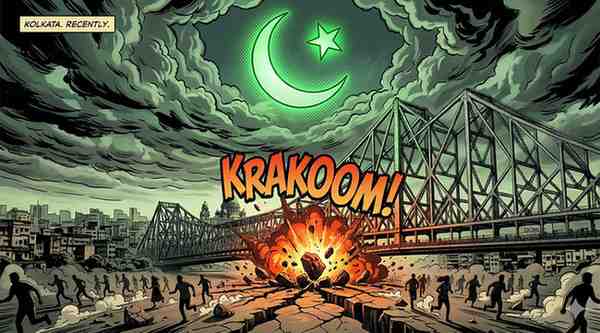
Rising Tensions: Decoding Pakistan’s Strategic Threat to “Hit Kolkata”
- Editor
- April 8, 2026
- Defence, Government, Politics
- 0 Comments
NEW DELHI, April 2026 — Geopolitical stability in South Asia has reached a critical flashpoint following a series of escalating signals over the last 72 hours. In a move that has stunned military analysts, Pakistan’s Defense Minister Khawaja Asif has issued a provocative warning, claiming that in the event of further escalation, Pakistan’s reach could extend as far as Kolkata.
The Three “Dots” of Escalation
Analysts suggest this threat is not an isolated outburst but part of a larger, dangerous puzzle connected to the anniversary of the 2025 Pahalgam attack. Three recent developments have signaled this shift:
- The Delhi Blackout: A massive civil defense mock drill was conducted across 13 districts in Delhi, involving simultaneous blackouts at 17 locations. This was designed to test “urban warfare preparedness” against potential asymmetric strikes deep within Indian territory.
- The “Decisive” Warning: Speaking from Kerala, India’s Defense Minister Rajnath Singh declared that “Operation [Sindhu] is not over yet,” describing future Indian responses as “unprecedented and decisive”.
- The 22-Minute Precedent: Singh officially revealed that during the 2025 response, Indian forces neutralized Pakistan’s defense structures in a mere 22 minutes, a message intended to shatter the “1947 mindset” of Pakistan’s generals.
Why Kolkata? The Strategic Logic
Naming Kolkata, a city nearly 2,000 kilometers from the western border, is viewed as a calculated “Strategic Depth Bluff”. The logic behind selecting this specific target includes:
- Continental Challenge: Pakistan aims to project that its missile capabilities can now threaten India’s Eastern Seaboard.
- Signaling Sleeper Cells: Intelligence inputs suggest terror groups like JMB and HuJI are attempting to activate sleeper cells to disrupt upcoming regional elections. Naming the city may be a signal to these internal assets.
- Economic Sabotage: As India’s eastern economic gateway, threatening Kolkata is a direct attack on global investor confidence and the Indian stock market.
A Paper Tiger? Pakistan’s Internal Reality
Despite the bold rhetoric, military assessments paint a different picture of Pakistan’s readiness. Since the “Operation Sindhu” strikes in 2025, Pakistan’s logistics chain remains shattered. Satellite imagery shows several of their airbases are still under repair. Furthermore, the Pakistani military is currently overstretched, dealing with conflict along the Durand Line with Afghanistan while facing total economic bankruptcy.
The End of “Strategic Patience”
The current climate indicates a total paradigm shift in Indian policy. As Rajnath Singh noted, surgical strikes are no longer a rare exception but a standardized process. With the first anniversary of the Pahalgam tragedy approaching on April 22, 2026, India has effectively redrawn its “Red Lines”.
Bottom Line
The era of strategic patience has ended. While Pakistan uses the “Kolkata” threat to project a narrative of victimhood through “False Flag” rhetoric, India has moved toward a state of highest vigilance. Khawaja Asif’s statement confirms one grim reality: a desperate enemy is often the most unpredictable.