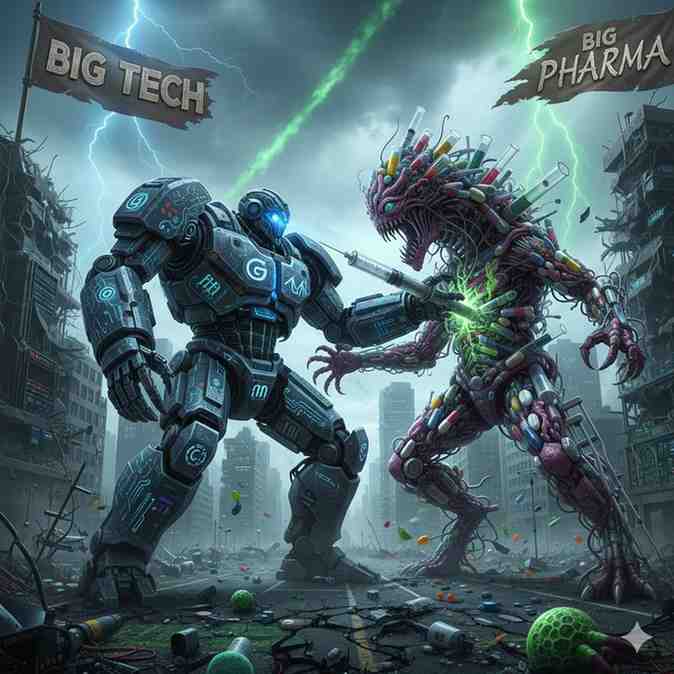
Big Tech vs Big Pharma 2026: Who Owns Healthcare Data and AI Diagnosis?
- admin
- January 30, 2026
- Capital Journal, Global Business
- 0 Comments
Key highlights
- Healthcare AI is being pulled in two directions: innovation (better diagnostics) and governance (privacy, consent, safety). World Health Organization+1
- India’s data protection regime is operationalized through the DPDP Act and notified rules, reshaping how consumer health data can be processed and secured. MeitY+1
- Public digital health rails emphasize consent-based exchange—meaning “data ownership” becomes, in practice, “permission + purpose + audit trail.” Ministry of Health and Family Welfare+1
First, a reality check: “ownership” is the wrong word
In 2026, the real contest isn’t about who owns health data like property. It’s about who controls:
- collection points (devices, apps, hospitals)
- standards and interoperability (how data moves)
- consent and governance layers (who can use it, and why)
- regulatory-grade evidence (what AI can be used for diagnosis)
WHO guidance on ethics and governance makes the point that AI in health raises risks around transparency, accountability, bias, safety, and human oversight—issues that force governance into the product itself. World Health Organization+1
The Big Tech advantage in 2026: rails + scale
Tech firms are naturally strong at data infrastructure: identity, cloud, security engineering, user experience, and continuous iteration. That matters for healthcare AI because modern models thrive on data pipelines and deployment discipline—but it also creates concern: when consumer platforms become health platforms, privacy and misuse risks scale too. World Health Organization+1
The Big Pharma advantage in 2026: clinical legitimacy
Pharma and medical-device ecosystems live inside regulated evidence standards: clinical trials, post-market surveillance, and patient safety culture. For diagnostic AI, the regulator’s posture is decisive. FDA’s materials on AI/ML-enabled software as a medical device highlight the regulatory approach and the need to manage modifications, safety, and effectiveness across a product lifecycle. U.S. Food and Drug Administration+1
India angle 2026: consent, privacy, and compliance become non-negotiable
India’s Digital Personal Data Protection Act and notified rules create a framework for lawful processing, citizen rights, and compliance obligations. For any healthcare AI business touching personal data, DPDP compliance becomes a board-level issue, not a legal checkbox. MeitY+1
On the public digital health side, official communications around ABDM emphasize consent-based exchange and security expectations for digital applications—pushing the ecosystem toward auditable, permissioned data flows. Ministry of Health and Family Welfare+1
Small questions people search
Can an AI “diagnose” me legally in 2026?
It depends on jurisdiction and classification. Regulators treat many diagnostic functions as medical device software, which requires evidence and controls. U.S. Food and Drug Administration+1
Is healthcare data “more sensitive” than other data?
Practically, yes—because harm from misuse is higher. That’s why WHO and national frameworks emphasize governance, oversight, and safeguards. World Health Organization+1
Who wins: Big Tech or Big Pharma?
The likely “winner” is the alliance: tech-grade infrastructure + pharma/clinical-grade evidence + compliance-grade governance. In 2026, trust is a product feature.