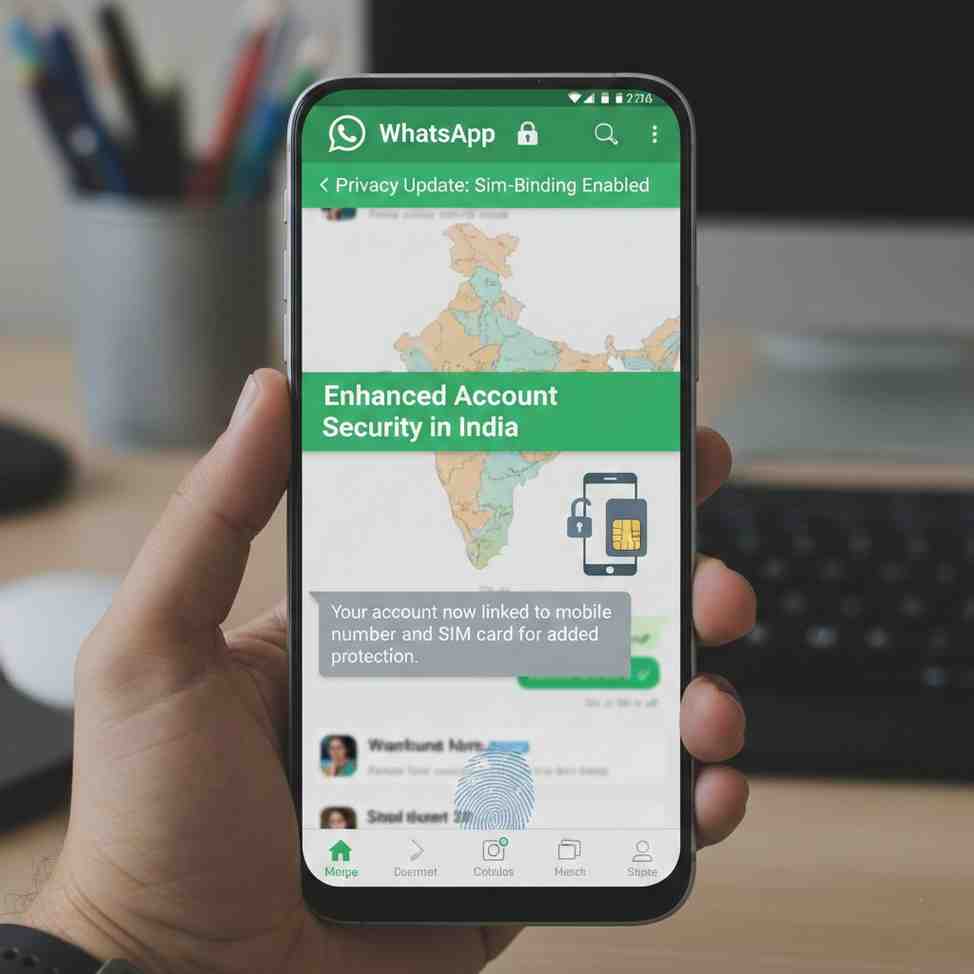
WhatsApp to Tighten Privacy and Implement “Sim-Binding” in India
- Editor
- February 26, 2026
- Business, Policy, Social Media
- 0 Comments
February 2026– Several regulatory developments are converging to fundamentally change how WhatsApp operates in India.
The information you’ve gathered reflects a mix of Department of Telecommunications (DoT) security mandates and Supreme Court/Competition Commission of India (CCI) legal battles. Here is a comprehensive report on the current situation.
1. The “Sim-Binding” Mandate
The Department of Telecommunications (DoT) has issued a directive under the Telecommunication Cybersecurity Rules requiring all messaging apps (WhatsApp, Telegram, Signal, etc.) to implement “SIM-binding.”
- The Rule: The app must be continuously linked to the physical SIM card associated with the registered phone number.
- The Restriction: If the registered SIM card is removed or is not active in the device, the app will cease to function.
- The Goal: This is a security measure to prevent “SIM-less” fraud, where scammers use Indian numbers from devices located outside the country to conduct phishing or impersonation scams.
- Deadline: The government has set a strict deadline of March 1, 2026, for compliance, with no extensions planned.
2. WhatsApp Web: The 6-Hour Logout
To complement SIM-binding, the DoT has introduced a significant change to how “companion devices” work.
- Automatic Logout: To prevent unauthorized remote access to accounts, all web-based sessions (WhatsApp Web) or desktop applications must automatically log out after 6 hours of activity.
- Re-Authentication: Users will be required to re-scan the QR code using their primary smartphone to stay active.
- Industry Pushback: Organizations like the Internet and Mobile Association of India (IAMAI) have argued this will be “highly disruptive” for professionals and businesses that rely on WhatsApp Web for 8–10 hour workdays.
3. Data Privacy and the “Ad Ban”
This stems from a long-running legal battle over WhatsApp’s 2021 Privacy Policy, which the CCI deemed an “abuse of dominant position.”
- Explicit Consent: On February 23, 2026, WhatsApp informed the Supreme Court it will fully comply with CCI directions by March 16, 2026. This means WhatsApp will no longer make data sharing with Meta (for advertising) a “take-it-or-leave-it” condition. Users must be given a clear “opt-out” or “opt-in” choice.+2
- The 5-Year Ad Ban: The CCI originally proposed a 5-year ban on Meta using WhatsApp data for advertising purposes. While an appellate tribunal (NCLAT) initially set this aside, the Supreme Court is currently reviewing the proposal.
- Court Sentiment: Chief Justice Surya Kant recently compared non-consensual data sharing to a “decent way of committing theft,” signaling a very pro-privacy stance from the bench.