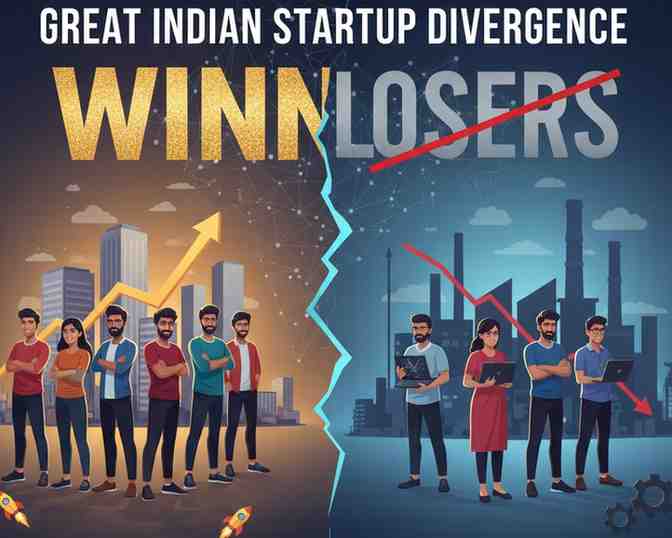
The Great Indian Startup Divergence: Winners and Losers of FY25 & Q3
- Editor
- February 16, 2026
- Business, Companies & Industry, Startups & Venture
- 0 Comments
Bengaluru, February 2026 — The latest earnings season has laid bare a growing divide in India’s tech ecosystem. While consumer-focused digital brands like Mamaearth and niche platforms like Stage are hitting record highs, established giants like Uber and Ola Electric are battling severe structural shifts and mounting competition.
Uber India: The ₹1,512 Crore Incentive Trap
Uber India’s latest filings reveal a staggering ₹1,512 crore loss for FY25, a massive jump from just ₹89 crore the year prior. On paper, their ride-hailing revenue appeared to collapse by 89%, falling to a mere ₹88 crore.
The Accounting Reality:
- Incentive Wars: The revenue “drop” is largely an accounting byproduct. Uber spent ₹2,516 crore on driver incentives and customer discounts to fight off Rapido. Under their policy, these payouts are subtracted from gross revenue, effectively wiping out their topline.
- Subscription Pivot: To survive, Uber has ditched its traditional commission model (15-20%) for a flat subscription fee for drivers, mimicking Rapido’s strategy. This allows drivers to keep 100% of the fare, but it leaves Uber searching for new ways to monetize its platform.
Ola Electric: A 55% Revenue Freefall
Once the undisputed leader of the EV revolution, Ola Electric is facing its toughest quarter yet. Revenue plummeted 55% YoY to ₹470 crore in Q3, driven by a sharp decline in vehicle deliveries—falling from over 84,000 units last year to just 32,680 units this quarter.
Key Concerns:
- Market Share Erosion: Ola’s market share has reportedly slipped to under 6% as of January 2026, down from nearly 25% a year ago.
- The “Service” Struggle: While the company managed to narrow losses to ₹487 crore (down from ₹564 crore), the improvement came from aggressive cost-cutting rather than growth. Investors are now questioning if the company can regain its “hyper-growth” status while dealing with persistent service quality complaints.
Ather Energy: The EV Recovery King
In sharp contrast to Ola, Ather Energy is surging. The company reported its highest-ever quarterly revenue of ₹995.7 crore, a 53% YoY jump.
Why it’s working:
- Narrowing Losses: Net losses slashed by 57% to ₹85 crore.
- Ecosystem Revenue: Unlike its rivals, 14% of Ather’s income now comes from “non-vehicle” sources like AtherStack software subscriptions and charging services.
- The “Rizta” Effect: Their move into family-oriented scooters has expanded their market share to nearly 19% nationally.
Mamaearth: Doubling Profits in a Crowded Market
Honasa Consumer (Mamaearth’s parent) proved that the “Clean Beauty” trend still has legs. The company doubled its profit to ₹50.2 crore in Q3, marking a 93% jump.
Strategic Wins:
- Record Revenue: At ₹601 crore, this was the company’s highest-ever quarterly revenue.
- Beyond the Flagship: While Mamaearth returned to double-digit growth, younger brands like The Derma Co. and BBlunt are growing at 25%+, proving that Honasa’s multi-brand “house of brands” strategy is working.
Stage: The Rise of “Bharat” OTT
The most surprising success story comes from Stage, a regional OTT platform focusing on Haryanvi, Rajasthani, and Bhojpuri content. Revenue exploded 6.2x to ₹111 crore in FY25.
The Niche Advantage:
- Paying for Quality: Stage now has 4.4 million paying subscribers, proving that rural and regional audiences are willing to pay for content that speaks their language.
- Unit Economics: While still in the red with a ₹28 crore loss, the company has drastically improved its efficiency—spending just ₹1.27 to earn ₹1, compared to over ₹2.20 last year.
Bottom Line
The “growth at all costs” era is officially over. The market is now rewarding startups like Ather and Mamaearth that have found a path to sustainable unit economics. Meanwhile, incumbents like Uber and Ola are finding that being the “biggest” is no longer enough to protect them from agile, subscription-based competitors and changing consumer sentiment.