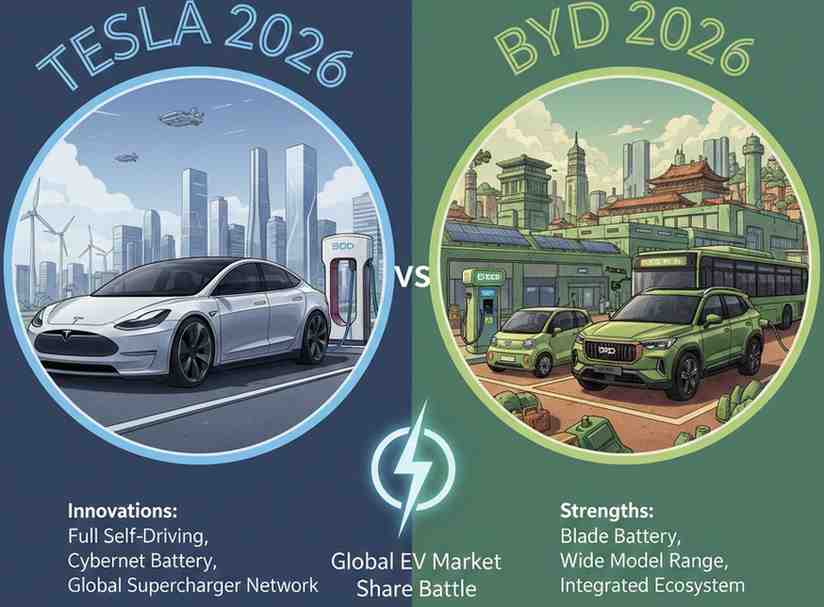
Tesla vs BYD in 2026: Who’s Winning the EV War by Sales, Margins, and Battery Power?
- admin
- January 24, 2026
- Business, Energy & Environment
- 0 Comments
Key highlights
- Tesla’s edge: software brand, charging ecosystem, manufacturing learning curve.
- BYD’s edge: vertical integration (batteries + vehicles) and scale across price bands.
- “Winning” in 2026 depends on geography: China vs US/Europe vs emerging markets.
- Margins are under pressure industry-wide; cost control is the real battlefield.
- Battery supply chain control is becoming as important as car design.
Who is “winning” by sales heading into 2026?
BYD’s official disclosures and filings show scale in new energy vehicles, including record annual NEV sales and revenue reported for 2024. BYD+1
Tesla’s latest 10-K filing remains the clearest primary source for its annual performance, risks, and competitive landscape. SEC
By 2026, the global “winner” won’t be one brand — it’ll be whoever dominates segments (premium vs mass) and regions.
What about margins — who has the better economics?
Margin leadership is now cyclical and incentive-driven. Tesla’s filings show how pricing actions, costs, and scale affect results. SEC
BYD’s annual report is the primary window into its business structure and profitability in its home market and overseas expansion. HKEXnews
In 2026, margins are less about “EV demand” and more about: manufacturing efficiency, battery costs, and policy tailwinds.
Battery power: why BYD is structurally dangerous
BYD isn’t only an automaker; it’s a battery-and-vehicle ecosystem. Vertical integration reduces dependency risk and supports aggressive pricing. That’s a strategic advantage when the industry is fighting a cost war.
Small question people search: “Will Tesla lose because BYD is cheaper?”
Not automatically. Tesla can still win on: software experience, charging reliability, and brand trust in certain markets. But BYD’s multi-model pricing ladder makes it harder for any single-product strategy to dominate mass segments.
What to watch in 2026
- Export tariffs and local manufacturing requirements.
- Battery mineral supply constraints.
- Price war intensity and how quickly each can cut costs without harming quality.