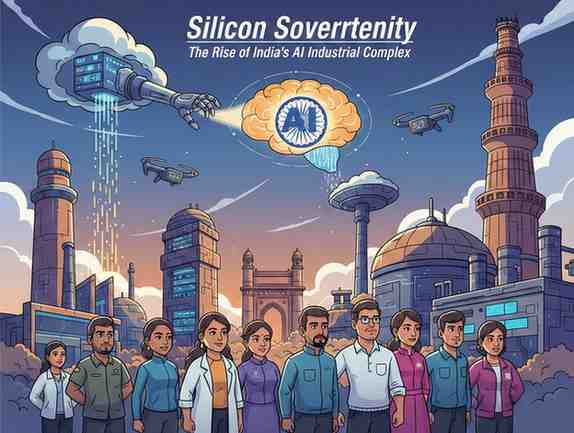
Silicon Sovereignty: The Rise of India’s AI Industrial Complex
- Editor
- February 20, 2026
- Artifical Intelligance, Business, Companies & Industry
- Ai, Industry, infrastructure
- 0 Comments
NEW DELHI — The 2026 India AI Impact Summit has concluded with a series of tectonic shifts in the global technology landscape. India is no longer just a destination for back-office operations; it has officially entered the “Silicon Arms Race” as a primary infrastructure provider.
From the world’s most aggressive enterprise AI rollout by Tata to Reliance’s multi-trillion rupee bet on “affordable intelligence,” here is a deep dive into the three pillars of India’s new AI economy.
I. The Anchor Deal: Tata & OpenAI’s 1 GW Vision
The most significant software-hardware handshake in recent history occurred between the Tata Group and OpenAI. This deal moves OpenAI’s compute power away from centralized Western hubs and directly into the heart of South Asia.
- The “HyperVault” Launch: OpenAI has signed as the inaugural client for TCS HyperVault, the newly formed high-density data center division of Tata Consultancy Services. The initial commitment is for 100 MW of AI-ready capacity, with a strategic roadmap to scale to 1 GW (Gigawatt).
- Enterprise Integration: Tata Group will deploy ChatGPT Enterprise across its entire global workforce. Furthermore, TCS will adopt OpenAI’s Codex to standardize AI-native software development across its engineering teams—a move intended to revolutionize the IT services delivery model.
- The “Stargate” Connection: This partnership aligns with OpenAI’s broader “Stargate” initiative, focused on massive compute clusters. CEO Sam Altman noted that India’s 100 million weekly ChatGPT users make local data residency a critical operational requirement.
Business Takeaway: For Tata, this isn’t just a sale of data center space; it’s a full-stack integration that positions them as the primary global partner for deploying and scaling OpenAI’s platforms.
II. The Factory Model: L&T and NVIDIA’s Gigawatt Ambitions
Engineering titan Larsen & Toubro (L&T) has partnered with NVIDIA to build what they describe as “Sovereign AI Factories.” This collaboration aims to ensure that India’s industrial data never needs to leave its borders to be processed.
- Scalable Infrastructure: The venture is scaling an NVIDIA GPU cluster at L&T’s Chennai campus to 30 MW, part of a massive 300-acre site. Simultaneously, a new 40 MW facility is under construction in Mumbai.
- Sovereign-by-Design: The facilities utilize NVIDIA’s full AI stack—including Blackwell GPUs, BlueField networking, and the AI Enterprise software suite. The goal is to provide a “sovereign cloud” for manufacturing, energy, and public services.
- Industrial AI Agents: L&T plans to use these “factories” to power its own “Lights-Out Factory” framework, using NVIDIA Omniverse to run fully autonomous industrial operations.
III. The Scale Disruptor: Reliance Jio’s ₹10 Lakh Crore Bet
Mukesh Ambani, Chairman of Reliance Industries, delivered the summit’s most ambitious keynote, pledging a staggering ₹10 lakh crore ($120 billion) over the next seven years. His message was clear: “India cannot afford to rent intelligence; we must own it.”
- Democratizing Intelligence: Ambani aims to repeat the “Jio Data Revolution” by slashing the cost of AI. He emphasized that AI will be used to augment human labor, particularly for the youth, rather than replace it, framing it as a tool for “limitless productivity.”
IV. The Strategic Core: Why India, Why Now?
This “Big Bang” of infrastructure is driven by three inescapable factors:
- Data Sovereignty: Laws requiring local storage of sensitive citizen and industrial data.
- Cost of Intelligence: The transition from high-cost “rented” AI (API-based) to low-cost “owned” AI (local inference).
- The Energy Equation: Unlike European or North American hubs facing energy shortages, Indian conglomerates like Reliance and Adani are anchoring their AI sites with massive captive renewable energy projects.