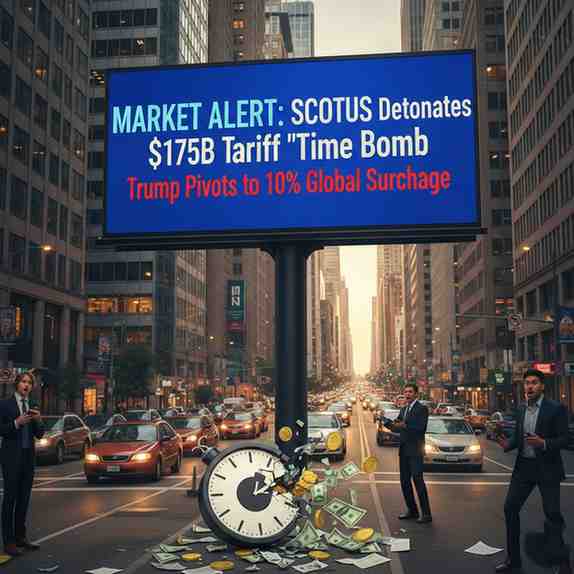
MARKET ALERT: SCOTUS Detonates $175B Tariff “Time Bomb”; Trump Pivots to 10% Global Surcharge
- Editor
- February 23, 2026
- Banking & Finance, Business, Economy, Global Business
- 0 Comments
WASHINGTON D.C. — In a seismic shift for global trade, the U.S. Supreme Court has effectively dismantled the cornerstone of the Trump administration’s trade policy. The 6–3 ruling has not only invalidated existing levies but has also sent shockwaves through corporate balance sheets and international diplomatic circles.
I. THE JUDICIAL REBUKE: “Emergency” Powers Overruled
On February 20, 2026, the Supreme Court ruled in Learning Resources Inc. v. Trump that the executive branch overreached by using the International Emergency Economic Powers Act (IEEPA) to impose broad-based tariffs. Chief Justice John Roberts clarified that while the President has “considerable” latitude, the authority to levy taxes on the American public remains a strictly Congressional prerogative.
The Fiscal Fallout:
- The $175B Liability: Analysts from the Penn-Wharton Budget Model estimate that the U.S. government now sits on a $175 billion to $179 billion refund liability.
- Litigation Surge: Over 1,500 lawsuits have already been filed in the Court of International Trade by giants like Costco and Goodyear to reclaim duties paid over the last year.
- The “Mess”: Dissenting Justice Brett Kavanaugh warned that the process of returning these funds will be a bureaucratic “mess” that could take between 2 to 5 years to resolve.
II. THE “PLAN B” PIVOT: The 10% Global Surcharge
Refusing to retreat, President Trump signed a new Proclamation just hours after the ruling. Effective 12:01 AM on February 24, 2026, a new 10% global tariff will be applied to nearly all imports.
This move relies on Section 122 of the Trade Act of 1974, a “balance-of-payments” authority that allows for temporary surcharges of up to 15% for a maximum of 150 days.
Strategic Exemptions: To prevent a total domestic supply chain collapse, the White House has carved out “National Interest” exemptions for the following sectors:
- Energy & Minerals: Critical minerals, fertilizers, and natural resources not available in sufficient U.S. quantities.
- Healthcare: Pharmaceuticals and active pharmaceutical ingredients (APIs).
- High-Tech & Transport: Certain electronics, passenger vehicles, and aerospace products.
- Agri-Essentials: Specific items including beef, tomatoes, and oranges.
III. THE INDIA ANGLE: A “Accidental” 8% Tax Cut
The ruling has created a bizarre win for New Delhi. Prior to the SCOTUS decision, India was facing an 18% reciprocal tariff under an interim trade framework.
With the 18% rate struck down as illegal and the new global surcharge set at 10%, Indian exporters are looking at an immediate 8% reduction in their U.S. tax burden. This has sparked intense debate in India regarding the necessity of recent concessions made to the U.S. to secure the now-defunct 18% deal.
“Nothing changes. They’ll be paying tariffs, and we will not,” President Trump remarked during a weekend press briefing, downplaying the reduction for trading partners like India.