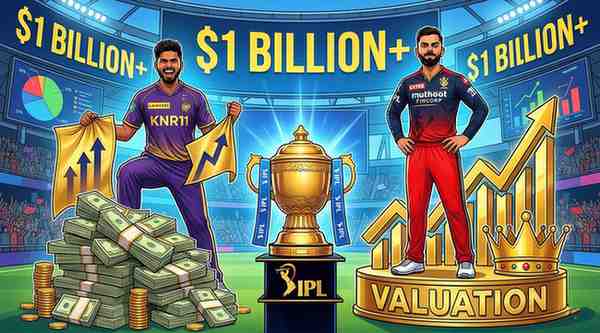
IPL’s Billion-Dollar Balance Sheet: KKR Dominates Revenue as RCB Leads in Value
- Editor
- March 28, 2026
- Business, Global Business, Sports
- 0 Comments
MUMBAI, March 2026 — As the 2026 IPL season kicks off, a new wave of financial disclosures has pulled back the curtain on the league’s true economy. While the scoreboard determines the champion on the field, the financial data reveals a different hierarchy where revenue volume and net profitability are telling two very different stories.
The headline for FY25 is the undisputed commercial ascent of Kolkata Knight Riders (KKR), which has officially become the league’s highest revenue generator, even as other legacy brands like Royal Challengers Bengaluru (RCB) prove to be more efficient profit machines.
The KKR Global Engine: ₹755 Crore in Revenue
Kolkata Knight Riders has emerged as the #1 team in terms of revenue, reaching ₹755 crore in the 2024-25 fiscal year. Unlike many other franchises that rely almost exclusively on the central pool of IPL broadcast rights, KKR’s strategy is built on a global footprint.
By leveraging a network of overseas franchises—including the Trinbago Knight Riders and Los Angeles Knight Riders—the brand has created a 365-day sponsorship cycle. This “always-on” model has allowed them to command premium domestic and international partnerships, insulating them from the volatility of a single two-month tournament.
Profit vs. Revenue: The RCB Paradox
In a fascinating twist of financial efficiency, high revenue does not always equal the highest profit. While KKR leads the top line, it currently ranks fourth in overall profitability.
In contrast, Royal Challengers Bengaluru (RCB)—despite having lower total revenue than the top leaders—has climbed to the third spot in profitability.
- The Loyalty Premium: RCB’s massive digital engagement and “cult-like” fan base allow them to maintain lower marketing acquisition costs compared to other teams.
- Merchandising & Hospitality: The franchise has successfully monetized its “unboxed” events and high-end hospitality suites, which offer significantly higher margins than traditional sponsorship slots.
The Salary Shift: Rahane and Dhoni Lead the Earnings
The 2026 season also highlights a surprising trend in player and support staff remuneration. While the “Big Three” of the younger generation command record-breaking auction prices, the total financial package for seasoned veterans remains unparalleled.
Ajinkya Rahane currently leads the pack in combined player and staff-related earnings, followed closely by MS Dhoni at ₹161 crore. These figures often include not just the base player salary, but significant performance bonuses, image rights, and “icon status” stipends that acknowledge their role in brand building beyond just their performance on the pitch.
The Loss-Making Giants
Behind the glitz of the revenue leaders lies a sobering reality for newer franchises. While established teams are printing money, the Gujarat Titans (GT) and Lucknow Super Giants (LSG) continue to navigate deep waters.
- The Franchise Fee Burden: Newer teams are still servicing the massive entry fees paid to the BCCI, which eats into their operational margins.
- High Burn: GT, for instance, reported a substantial loss this fiscal year as they continue to invest heavily in grassroots infrastructure and high-cap player retentions in an attempt to buy long-term brand equity.
Bottom Line
The IPL has officially transitioned from a sports league to a mature financial ecosystem. KKR has mastered the art of the global franchise, while RCB has mastered the art of fan-driven profitability. However, as player salaries for veteran icons continue to touch the ₹160 crore mark, the pressure to turn a profit is higher than ever. In 2026, staying in the “Black” is becoming as difficult as winning the “Blue” trophy.