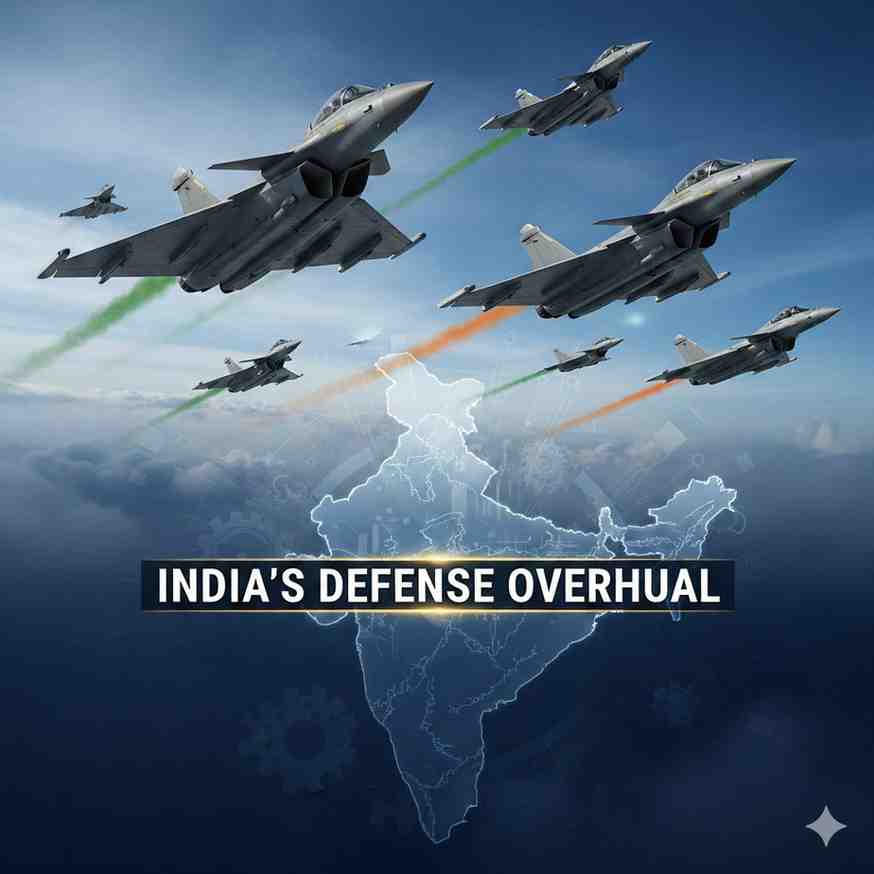
India’s Defense Overhaul: The ₹3.25 Lakh Crore Rafale Deal and the Fast-Track S-400 Shield
New Delhi, February 2026 — The Indian government has signaled a massive shift in its defense posture, moving to close critical air superiority gaps with a historic acquisition of 114 Rafale fighter jets and a rapid replenishment of its S-400 missile systems.
The move, totaling over ₹3.35 lakh crore, is being viewed as a “reset” for India’s military readiness, prioritizing high-tech deterrence over long-drawn-out procurement cycles.
The Rafale Juggernaut: India’s Biggest Defense Bet
For years, the Indian Air Force (IAF) has grappled with a dwindling squadron strength. The newly finalized deal for 114 Rafale jets, valued at approximately ₹3.25 lakh crore, aims to resolve this crisis permanently.
Unlike previous limited “fly-away” deals, this acquisition marks a pivot toward long-term air dominance. The deal isn’t just about buying planes; it’s about a massive injection of French aerospace technology into the Indian ecosystem. However, the price tag is staggering, making it one of the largest single defense contracts in the nation’s history.
Replenishing the Shield: The ₹10,000 Crore S-400 Order
While the Rafale jets secure the skies, the ground-based defense is getting an urgent upgrade. India has placed a fast-track order with Russia for 288 S-400 missiles, worth nearly ₹10,000 crore.
The order is strategically split to handle varied threats:
- 120 Short-Range Missiles: To intercept drones and close-range projectiles.
- 168 Long-Range Missiles: Designed to take out enemy aircraft and cruise missiles at significant distances.
The “fast-track” nature of this order is a direct response to recent border tensions. Reports suggest that India’s missile stockpile saw heavy utilization during recent defensive maneuvers, leading to an estimated expenditure of ₹34,000 crore just to maintain a defensive perimeter. The government is now moving to refill those silos before any further escalation occurs.
The “Pakistan Factor” and the Cost of Defense
The urgency behind these multi-billion dollar deals stems from recent “skirmishes” and border incidents that exposed the high cost of modern warfare. Insiders suggest that while the Indian team “cleaned the floor” in recent engagements, the financial toll of defense is eye-watering.
By spending ₹10,000 crore now to restock, the government is attempting to move from a reactive “emergency purchase” mode to a proactive deterrent stance. The goal is simple: ensure the cost of aggression is too high for any adversary to consider.
Diddling the Dollar? The Geopolitical Undercurrent
Beyond the hardware, a subtle geopolitical shift is occurring. Reports indicate that Russia may be moving back toward US Dollar (USD) transactions for these deals.
Despite global “de-dollarization” talk, a potential offer from the US administration to ease sanctions may bring Russia back into the USD system. This shift would simplify India’s payment hurdles, which have been plagued by currency conversion issues since the start of the Ukraine conflict.
Bottom Line
The era of “wait and watch” in Indian defense procurement is over. Between the ₹3.25 lakh crore Rafale deal and the immediate ₹10,000 crore S-400 restock, India is making it clear that it is willing to pay the price for absolute air sovereignty.
While critics may point to the massive drain on the exchequer, the military’s stance is firm: in a neighborhood this volatile, the only thing more expensive than a world-class defense is a second-best one.