India Strengthens Air Power: A ₹3.25 Lakh Crore Leap with 114 Rafale Jets
- Editor
- February 18, 2026
- Business, Defence, Tech & Innovation
- 0 Comments
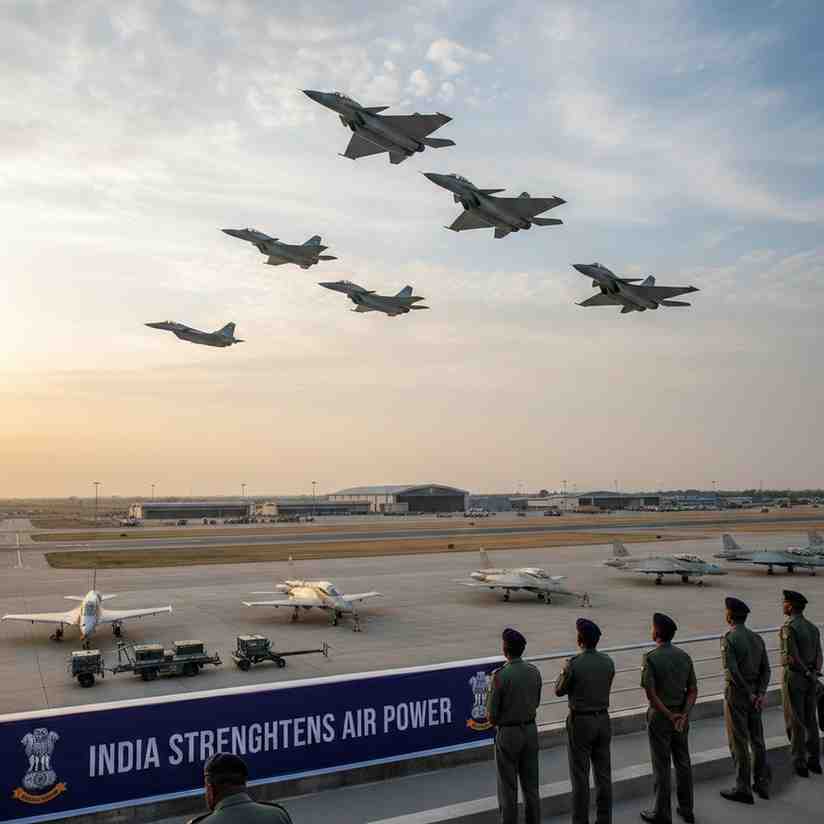
New Delhi, February 2026 — In what is being described as the most significant defense procurement in India’s history, the Indian government has finalized a landmark deal to acquire 114 Rafale fighter jets. At a staggering valuation of ₹3.25 lakh crore, the acquisition marks a massive commitment to modernizing the Indian Air Force (IAF) and securing regional air dominance.
The Rafale Resupply: Addressing the Squadron Gap
For years, defense experts have warned of the IAF’s dwindling squadron strength. This new deal for 114 jets—often referred to as the Multi-Role Fighter Aircraft (MRFA) program—is the long-awaited solution. Unlike previous smaller batches, this “mega-order” ensures a standardized, high-tech fleet capable of handling multi-front threats.
The Rafale is more than just an aircraft; it is a strategic asset equipped with advanced electronic warfare suites and long-range Meteor missiles that fundamentally shift the balance of power in the subcontinent.
Fast-Tracked Shield: The S-400 Missile Surge
While the Rafale deal secures the skies, a parallel move is reinforcing India’s ground-to-air defense. India has placed a fast-track order for 288 S-400 missiles from Russia, valued at approximately ₹10,000 crore.
To create a comprehensive “air defense umbrella,” the order is strategically categorized:
- 120 Short-Range Missiles: To neutralize immediate tactical threats like drones and cruise missiles.
- 168 Long-Range Missiles: Designed to intercept enemy aircraft and ballistic missiles at distances that keep Indian airspace untouched.
Lessons from the Border: The High Cost of Readiness
The urgency behind these orders stems from recent regional tensions. Reports indicate that recent skirmishes led to a significant depletion of missile and ammunition stocks. Insiders suggest that maintaining a defensive posture during these periods cost the exchequer nearly ₹34,000 crore in operational readiness and ammunition usage.
The government’s shift to a “fast-track” procurement model is a direct response to this: rather than waiting for long-drawn bureaucratic cycles, the focus has shifted to immediate replenishment to avoid being caught off-guard in a “two-front” scenario.
Geopolitical Chess: Payments and Sanctions
The deal comes at a complex time for global diplomacy. While India remains a key partner for Russian defense, global reports suggest a potential shift in payment structures.
Under pressure from US-led sanctions, there are indications that Russia might move back toward the US Dollar (USD) system for large-scale deals. This follows an offer from the US administration to ease certain sanctions in exchange for Russia curbing “de-dollarization” efforts—a move that would simplify India’s massive payment obligations for the S-400 systems.
Bottom Line
India is no longer just “maintaining” its military; it is aggressively overhauling it. By committing to the 114 Rafale jets and a massive S-400 missile stockpile, New Delhi is sending a clear message of deterrence. The era of “wait and watch” procurement has been replaced by a “swoop and secure” strategy, ensuring that the Indian Air Force has the numbers, the technology, and the ammunition to back its sovereignty.